


Guilford published a thick volume to mark its bicentennial: the Official History of Guilford, Vermont, 1678-1961, assembled by Broad Brook Grange No. 151 and filled with genealogies, biographical sketches, and the kind of half-remembered stories that small towns keep in their attics. Around Guilford, people still call it "the green book." Many households own a copy. Few, presumably, have ever imagined its contents walking and talking on a stage.
That is what will happen on the first weekend of October, when Guilford Center Stage premieres "Vermont Mythos—a small town fable," a new full-length play written and directed by the Guilford playwright Michael Nethercott. Performances run Thursday, Friday, and Saturday, October 1-3, at 7:30 p.m., with a Sunday matinee on October 4 at 2 p.m., at the Broad Brook Community Center, 3940 Guilford Center Road. General admission is $16 at the door, payable by cash, check, PayPal, or Venmo.
The play was commissioned. Several months ago, the theater company asked Nethercott—a longtime collaborator who has adapted "Spoon River Anthology" and other works for the group—to create something that would recognize the town's backstory. Producer Don McLean framed the timing: "It seemed fitting in a year when the nation is celebrating its 250th anniversary to touch on local history." The result, he said, "blends local legends, historical figures, and imaginative storytelling into a theatrical fable exploring the human experience with humor, mystery, and heart."
Nethercott's method was to go digging. "To get off the ground," he said, "I started researching various historical figures, both noted and obscure, with connections to Guilford, to create a cast of characters. Some are represented directly onstage, while others are referenced. I came up with a concept that draws from the town's backstory, but also goes in a more fantastical direction, exploring what it means to be human."
The cast numbers sixteen: Sasha Cooke, Geof Dolman, Denise Evans, Warren Friedman, Jenny Holan, Alex Lacey, Dyana Lee, Nick Morgan, Zoe Nelson, Brandy Reynolds, Addison Rhys, Yayba Rios, Rebecca Saunders, Lois Scott-Conley, Bob Tucker, and others. Alongside the historical figures come a Greek chorus and, in Nethercott's phrase, a pestering jester.
The historical figures are not decorative. Guilford's past is unusually crowded with consequential people. The best known is Ethan Allen, who in 1783 was sent to the town with the militia to enforce martial law and collect taxes—an episode remembered, with some understatement, as the "Guilford War." The trouble had been brewing since the Revolution, when Yorkist and Vermont factions in town each maintained their own set of officials, sparring for control. Matters grew bad enough that Vermont's government dispatched its most famous citizen to settle them. Eventually many of those opposed to Vermont rule left and resettled in New York.
Then there is Royall Tyler, who moved his law practice to Guilford in 1791 and went on to serve as Windham County state's attorney, an assistant judge of the Vermont Supreme Court, and eventually chief justice. Tyler is also the author of "The Contrast," the first American comedy to be professionally staged, and of "The Algerine Captive," a novel that introduced the Yankee type into American literature. His wife, Mary Palmer Tyler, wrote what is described as the country's first child-rearing book by a woman. The Tylers lived in Guilford Center Village in the 1790s—and would almost certainly have walked the ground that later became the Grange hall and community center where the play is now performed.
And there is Lucy Terry Prince, a Guilford resident who holds the distinction of being the first chronicled Black poet in America. Kidnapped in Africa as a child and enslaved in Deerfield, Massachusetts, she composed "Bars Fight," a ballad about a 1746 attack on Deerfield settlers that is the oldest known poem by an African American. In 1756 she married Abijah Prince, a free Black man who purchased her freedom; in the 1760s the family moved to Guilford, where they became early Black landowners. A Vermont roadside marker now honors the couple.
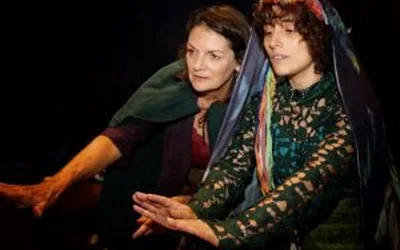
Nethercott's narrator is an original settler: Silence Rice, who lived on what is now Weatherhead Hollow Road. She and her husband Micah were among Guilford's first families—Micah Rice is generally credited with establishing the town's first homestead in 1761, and their daughter Molly, born that September, is recorded as the first white child born in Guilford. Silence is joined by a stranger figure: Old Mother Honeywell, a mysterious early Guilfordite said to have haunted the neighborhood of Packer Corners and the mists of Weatherhead Hollow, the region bordering the town of Leyden where an 18th-century religious cult took root. Mother Honeywell was thought to be a witch, possessed of supernatural powers. She and her Familiar are characters in the play, performed by Dyana Lee and Yayba Rios.
There is a further layer of local resonance in the setting itself. Another character in "Vermont Mythos" knew the Grange stage intimately: Charles Washington Henry, born in Guilford in 1850, who became Vermont's most prolific and accomplished scenic artist. His family company produced theater curtains and booked shows at town halls and Grange halls across the state. Around 1900, Henry painted the scenic curtains and flats for the Broad Brook Grange building—and those same painted curtains will be seen in "Vermont Mythos." The play will be performed in front of the scenery its own character created.
The venue has its own story of survival. Broad Brook Grange No. 151 was established in 1874, its members meeting in private homes at first. In 1895 they voted to build their own hall; the building that stands today dates to 1896. For generations it was Guilford's gathering place. By the 2010s, though, it needed saving. In 2013, the Vermont Council on Rural Development visited Guilford for a community discussion, and renovation of the Grange building emerged as a top priority. A citizens' group formed the nonprofit Broad Brook Community Center and in January 2018 purchased the building from the Grange. A study put the renovation cost at roughly $1.2 million; the group raised nearly $880,000 and completed a first phase that added an ADA-compliant ramp, exterior fire stairs from the second-floor auditorium, accessible bathrooms, and a kitchen upgrade. The building is now fully accessible—which is why the play's producers can say, plainly, that everyone can come.
Guilford Center Stage itself was founded in 2015, and for an unusual reason: most theater companies start with a desire to put on plays and then hunt for a venue, but GCS was created to make use of the mostly empty stage at what was then the Grange—the only theater space in Guilford. It is a project of Broad Brook Grange No. 151, which is marking its 150th anniversary. The company has leaned toward work by Vermont playwrights, and specifically toward Guilford authors, including Verandah Porche and Charles Henry. "Vermont Mythos" is its fall 2026 production, following the spring program of short plays.
What Nethercott has made of all this is deliberately not a history lecture. It is a fable—one that takes a town's real settlers, its real judges and poets and witches and painters, and asks what their stories have to do with being alive now. The green book has been sitting on Guilford's shelves for more than sixty years. For one weekend in October, it gets up and speaks.