


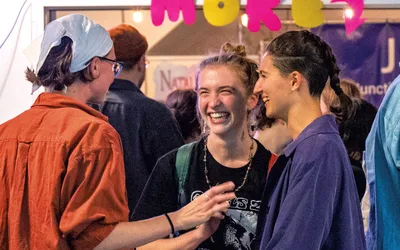
On the first Friday of October, the old railroad village of White River Junction fills up with people carrying stapled booklets and hand-drawn stories. TWIST — the Twin State Comics and Zine Fair — returns to Junction Arts & Media on Friday, October 2, from 4 to 8 p.m., with 35 exhibitors spread across the community media center at 5 South Main Street. There is no admission charge, and there is no fee to table either. That combination is the whole point.
Now in its fifth year, TWIST began modestly. The first edition, then billed as the TWIn STate Zine & Comic Fair, was held on November 4, 2022, at the same venue, an evening meant to let local artists and students from the nearby Center for Cartoon Studies put their self-published work in front of neighbors. It has grown into an annual fixture of the village's First Friday calendar, and this year's edition comes with a run of bonus programming: a gallery show at the Filling Station Bar running from September 25 through October 5, a live comics reading there on Thursday, October 1, from 7 to 9 p.m. (21 and over), and a family-friendly Zine Factory workshop at the Center for Cartoon Studies on Friday from 5:30 to 6:30 p.m.
The exhibitor list reads like a cross-section of a scene rather than a curated brand. There is Directangle Press, the studio of Josh Dannin; Go Press Girl!, run by Vik Alexander and Rachel Bivens; the Sneep Collective, the pairing of Michael Albrecht and Iris Gudeon; and a long roster of individual artists including Alexandra Gallant-Lee, Alex Bullett, Alex Murray, Allison Wong, Andy Lindquist, and Anya Driffill, among many others. The work on the tables is as varied as the names. Meg Richardson, whose comic "Ideas for the New York City Officials Implementing Rat Birth Control" ran in the New Yorker in 2024, is one of the 35; her deadpan suggestions include dressing male rats in pink shorts embroidered with small whales and encouraging them to recount the plot of Dune on first dates. Allison Wong brings "Come, Sit, Stay," a memoir threaded with musings on pet funerals. Syne Mitchell offers "My Ex, Vlad," a vampire-werewolf romantic comedy. Sierra Edwards contributes "Vantage Point," a thoroughly abstract story of squares in a grid that somehow still narrates. The organizers describe the aim plainly: diversity and discovery. Keeping the event free for attendees, and free for exhibitors, is how they get there.
That such a fair exists at all, in a village at the confluence of the White and Connecticut rivers, is the stranger and better story. White River Junction was built as a trading post and then became a booming railroad hub through the first half of the twentieth century. When freight trucks took the railroad's business, the downtown hollowed out. What refilled it, improbably, was cartooning.
In 2005, the cartoonist James Sturm and Michelle Ollie founded the Center for Cartoon Studies in the village's historic downtown, a two-year institution devoted to sequential art — comics and graphic novels — offering a Master of Fine Arts degree, one- and two-year certificates, and summer workshops. It is, by common description, the only college-level training program of its kind in the United States. Sturm had come to the idea through a long career: an MFA from the School of Visual Arts, co-founding the Seattle alternative weekly The Stranger, art-directing it, and drawing the award-winning graphic novel The Golem's Mighty Swing. Ollie became the school's president. Their bet was that a small, walkable, slightly rough-edged downtown could support a school for people who draw stories — and that the school could, in turn, support the town.
The bet paid off in ways that are easy to measure and easier to feel. By the end of the 2000s, the school was drawing roughly a million dollars a year into the local economy, according to its president, and reporters were describing an aging railroad town revitalized by an unlikely source: cartoonists. The school's own mission statement commits it not only to teaching visual storytelling but to improving the local cultural and economic quality of life — a promise that shows up in the storefronts and studios along South Main Street. Its alumni have gone on to national prominence; Tillie Walden, a graduate, was appointed Vermont's Cartoonist Laureate. A critical mass of creative-minded locals invested time and money in the compact downtown over the following decades, burnishing it while, as one longtime business owner put it, retaining its "rough edges."
That is the soil TWIST grows in. The fair is not a convention with a badge line and a corporate floor; it is a neighborhood gathering with a national reach, where a New Yorker contributor and a first-time zinester can set up tables a few feet apart and neither pays for the privilege. The absence of an exhibition fee is not a small administrative detail. It is the mechanism by which the fair stays open to people whose work might not otherwise find an audience — the memoirists, the genre experimenters, the formalists drawing squares in a grid.
Junction Arts & Media, the host, is itself a piece of the village's media landscape. Formerly known as CATV, the community media center has long served the Upper Valley as a place to make and broadcast work, and it has hosted film programming across a range of White River Junction venues over the years, from the Briggs Opera House to the Hotel Coolidge to Northern Stage. Its building on South Main is a short walk from the Center for Cartoon Studies, which is where the Zine Factory workshop will run on Friday evening — a fitting loop, students and alumni tabling at the fair by day, teaching the form to newcomers by night.
The Upper Valley's transformation into a comics hotbed is the kind of thing that gets noticed in retrospect. A railroad town loses its reason for being, then finds another one in a school that teaches people to tell stories in panels. The students stay, or come back; the alumni teach; the town becomes a place where a fair like TWIST can be free to enter, free to table at, and full of work you have never seen before. On October 2, from 4 to 8 p.m., that is exactly what will be on the tables at 5 South Main Street.