


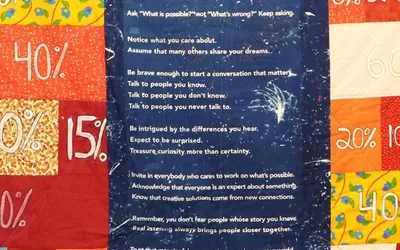
On a Thursday evening in mid-October, a crowd will gather in the galleries of the Brattleboro Museum & Art Center to look at a quilt that measures roughly seven and a half feet by eight and a half feet. It is a colorful thing, threaded with cyanotypes of flowers and leaves, its border printed with the score of a piece of music. But the object itself is only half the story. The other half is the unlikely chain of hands that made it — some of them working inside the walls of a Vermont prison, others reaching in from the outside.
The quilt is called Fractured, Not Broken, and it is the centerpiece of a project conceived by Marie-Pierre Py, an artist and restorative justice practitioner with Interaction: Youth Services & Restorative Justice, a Windham County nonprofit that leads restorative circles inside the prison. For about three years, Py had been leading support groups at Southern State Correctional Facility in Springfield, Vermont. She noticed something: many of the men were interested in the work of reflection and repair, but the idea of sitting in a talking circle and being vulnerable in front of others was intimidating. Py is a quilter herself, and she had an insight. Not everything has to be said out loud.
"Working with your hands and making art is therapeutic," she told Vermont Public. "It's a way to allow things to start moving, even if you don't have words for them yet."
So from September 2025 into the spring of 2026, Py led a quilting workshop inside SSCF. The men who joined — identified in museum materials only by their initials, JA, GB, AC, DC, DF, QG, RG, FN, JO, TR, and JW — designed, pieced, and painted the quilt block by block, each one carrying something of its maker's own experience. They also took part in a two-day cyanotype workshop facilitated by the artist Evie Lovett, which is where the ghostly blue botanical images that run through the quilt came from. Py and Suzie Walker assembled and bound the finished top. A University of Vermont student named Alli Cooper-Ellis, who had helped conduct research on life inside the prison, composed a piece of music called "Quilted Forest," and its score became the quilt's border.
The incarcerated quilters were not made available for interviews, but the museum has preserved their artist statements, and one of them speaks plainly about what the work meant. "From the very beginning, I knew I wanted to depict a ship coming home from a long, hard voyage," the statement reads. "I'm ready to go home. And ready to find peace."
The project is an initiative of Interaction, and it is supported by the Vermont Prison Research and Innovation Network, known as PRIN — a partnership between UVM's Justice Research Center and the Vermont Department of Corrections that works to elevate the voices of people who live and work in prisons, with the aim of understanding prison ecosystems and advancing systemic change. That partnership is part of what gives the quilt its double life: it is both a work of art and a piece of research-adjacent storytelling, a way of letting people who are usually spoken about become the ones doing the speaking.
What happened next is the part that turned a prison art project into something larger. Once the incarcerated artists had finished their work, the project deliberately opened outward. Through the summer of 2026, local residents were invited to add their own stitches to the quilt — to literally put their hands where the men's hands had been. At Brattleboro's Gallery Walk on Friday, August 7, 2026, community members lined up to contribute hand-stitched pieces. Photographs from that evening show a five-year-old from Staten Island, a six-year-old from Whitingham, and a man from Putney all bent over the same fabric. The quilt became, in the museum's words, "a creative dialogue between community members inside and outside prison walls."
That is the idea behind the title. A quilt is a thing made of fragments — cut pieces, joined seams, visible fractures — and the whole point is that the fractures do not destroy it. They are how it holds together. The name Fractured, Not Broken carries that meaning without spelling it out, and it carries a second meaning too: the people who made it are, in the project's framing, not defined by the worst thing they have done, nor by the walls currently around them.
The quilt has been on view at the Brattleboro Museum & Art Center since September 9, 2026, and it will remain there through November 1. The October 15 gathering is a celebration of the project's completion — a chance to honor the many individuals and organizations whose contributions brought it into being, from the incarcerated artists to the workshop facilitators to the hundreds of southern Vermonters who picked up a needle over the summer. Admission is free, and the event begins at 5:30 p.m. at the museum, 10 Vernon Street.
There is one more chapter planned. After the exhibit closes at BMAC, the quilt is scheduled to travel back to where it began — to Southern State Correctional Facility, where it will hang inside the walls. The men who made it will, in many cases, still be there to see it. Some of them, eventually, will come home to the same community whose stitches are now part of the same cloth. The quilt will have gone out into the world and come back, which is, in its own quiet way, exactly the voyage one of its makers described: a ship coming home from a long, hard trip.