


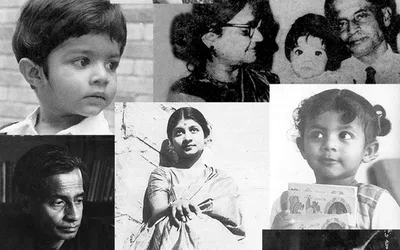
Akaina Ghosh never learned to speak Bengali. That absence sits at the center of Buddhadeva, the solo performance Ghosh brings to Next Stage Arts in Putney on Friday, October 23, at 7:30 p.m., with doors opening at 6:45. The show is, in the presenter's words, both a love letter and a conjuring: an attempt by a second-generation American-Bengali artist to reach a great-grandfather whose language they cannot speak.
The great-grandfather was Buddhadeva Bose, who lived from November 30, 1908, to August 14, 1974, and who remains one of the most formidable figures in twentieth-century Bengali letters. Bose was born in what was then British India, studied English language and literature at the University of Dhaka, and went on to write poetry, novels, short stories, plays, and essays, alongside a substantial body of criticism and editorial work. He is counted among the five poets credited with introducing modernity into Bengali poetry, and the assessment often repeated about him is that since Rabindranath Tagore, Bengali literature has not seen a more versatile talent.
His reach extended well beyond his own pages. He was an influential editor and critic in his own time, a shaper of the literary conversation as much as a participant in it. His poetry drew, by turns, on Tagore and on Western poets, Baudelaire prominent among them, a hybrid inheritance that makes him a fitting ancestor for a piece about translation and crossed languages.
That is the territory Buddhadeva occupies. Set along the Ganga River, the performance moves through poetry, music, ritual, memory, and translation as Ghosh tries to awaken the presence of an ancestor whose words survive but whose tongue does not pass down the family line. The piece is explicitly framed around a non-binary, second-generation American-Bengali identity, asking what lineage means when the language that carried it has been lost, and what a descendant can offer in its place.
Ghosh is a New York-based actor, playwright, and composer whose biography makes the project legible. They hold an MFA in Acting from NYU Tisch and are represented by Framework Entertainment, and they have worked across the United States and internationally, with debuts in New York, Los Angeles, Switzerland, Greece, and the San Francisco Bay Area. Their Bay Area credits include a Theatre Bay Area Award-nominated turn as Tilly in Time Sensitive with Ragged Wing Ensemble. As a playwright, Ghosh received the June Anne Baker Prize from PlayGround in 2022 and the Innovators Series Award from 3Girls Theatre in 2019 and 2020, and co-created works including Two Coins for the Ferryman and Sita's Gift. Their stated artistic preoccupation, reconstructing historically significant narratives through a gender expansive lens and centering queer voices, reads as a direct description of what Buddhadeva sets out to do with a literary patriarch.
The venue suits the material. Next Stage Arts occupies a historic church building at 15 Kimball Hill in Putney, a small village in Windham County, and the organization is marking sixteen years of programming and the tenth anniversary of the renovations that turned the building into a performance and community center. A solo show built on ritual and memory, staged in a converted sanctuary in a Vermont village, is the kind of booking the venue has built its reputation on: intimate, cross-cultural, and unlikely to appear at a larger regional house. Tickets are available through nextstagearts.org.
What audiences will see is not a biography or a lecture on an eminent poet. It is a descendant's attempt at contact, conducted through the materials available to someone who cannot read the family archive in its original tongue. Translation, in this framing, is not a technical problem but an emotional and spiritual one, a way of asking whether an ancestor can be reached across a century and a language barrier at once. Ghosh's piece treats the Ganga as its setting and its presiding image, a river that carries ritual, memory, and the dead.
For a Vermont audience, the appeal is partly the rarity: a Bengali literary legacy, a queer and non-binary artist's reckoning with inheritance, and a story about what gets lost between generations, all in a former church on a Putney hill. The performance begins at 7:30 p.m. on Friday, October 23.