


For ten years now, the Vermont Symphony Orchestra has been running an experiment in which the audience, not the printed program, decides what gets played. The series is called Jukebox, and its tenth season brings it back to the St. Johnsbury Athenaeum at 1171 Main Street on November 12, 2026, for an evening that no one — not the players, not the host, not the people in the seats — can predict in advance.
The premise is simple and a little nervy. The Jukebox quartet draws from a pool of sixteen possible selections, and eight of them get performed. The choosing happens in real time, with the audience's help, as pieces are pulled from the "jukebox" on the spot. The VSO describes it as "a game where we don't know exactly what's coming." Each of the three stops on this fall's tour gets a wholly different program, because the draw is different every night.
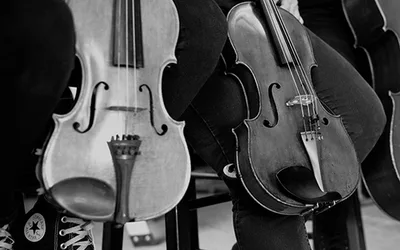
The sixteen candidates are a deliberate cross-section of what the series has built over nine previous seasons, plus some fresh additions. There are heavy hitters of the string-quartet repertoire — Beethoven and Bach — alongside modern voices like Jessie Montgomery and Caroline Shaw. There are solos and duos mixed in with full-quartet works, and the range is meant to span the various styles and genres Jukebox has come to be known for. The ensemble for the evening is Brooke Quiggins-Saulnier and Joana Genova on violin, Stefanie Taylor on viola, and John Dunlop on cello, hosted and curated by Matt LaRocca.
LaRocca is the thread that runs through the whole story. A composer, violist and guitarist who came to Vermont after finishing a doctorate in musical arts at Boston University, he caught the attention of then-new VSO executive director Ben Cadwallader with an immersive multimedia exhibit called "Arctic Voices" at the Champlain College Art Gallery in January 2016 — a piece he had composed after a month-long Arctic Circle sailing residency in 2012. Cadwallader later told Seven Days that he remembered thinking, "I want to get inside the brain of the person who cooked this thing up." The two met, and the symphony began trying things it had not tried before.
Out of that partnership came Jukebox, an innovative chamber series co-presented by the VSO and Burlington's ArtsRiot, curated by LaRocca, and built around a sliding-scale payment option — a pointed departure from the usual concert-hall economics. It worked. By January 2017 the VSO was reporting a resounding success, with musicians Stefanie Taylor and John Dunlop looking out at a packed house at ArtsRiot. Seven Days, profiling LaRocca that same period, noted that Jukebox was starting its second year in expanded form, reaching three additional venues around the state. A decade on, that expansion has become the series' defining shape: an intimate, relaxed quartet program that travels rather than sitting still in one hall.
The tenth-anniversary framing is the VSO's own. The orchestra bills this fall's run as "our tenth season of Jukebox," and the tone of the announcement is less gala than garage band: "we're playing the hits, deep cuts, and brand new songs." The Burlington stop on the tour, at Burlington Beer Company on November 13, is listed as running an hour and a half with doors at 6:30 p.m., all ages, and the same sixteen-selection format.
What makes the St. Johnsbury date distinctive is the room. The Athenaeum is a legacy of the Fairbanks family — the scale-manufacturing dynasty that put St. Johnsbury on the map — built in 1871 and given to the town by Horace Fairbanks, president of the E. & T. Fairbanks Company and a governor of Vermont. It opened with roughly 8,000 books, chosen by the librarian William Frederick Poole, and it holds the distinction of being the oldest unaltered art gallery in the United States. It is a private, nonprofit public library and art gallery, and it is not a conventional concert venue: past Jukebox performances there have taken place in the Art Gallery itself, with limited seating.
That pairing is not new. In October 2025 the Athenaeum hosted a Jukebox program titled "Strength and Hope," a concert built around composers who wrote in the face of hardship — music composed in prison camps, music that called out injustice, music charged with the need to speak out. The program that night ran from Russell Peck and Beethoven to Ethel Smyth, Gideon Klein, Shostakovich, Frank Horvat, Milad Yousufi, Zoltan Almashi and Woody Guthrie's "This Land Is Your Land." It sold out, and tickets were free, supported by the Athenaeum, with advance registration required.
That history is a useful guide for anyone planning to attend in November. The Athenaeum's Jukebox concerts have been free but ticketed, with registration required and seating capped by the size of the gallery. The VSO's event listing directs attendees to get tickets, and the Athenaeum's own listings for past Jukebox dates have pointed to Eventbrite registration. Checking with either the VSO or the library ahead of time is the safe move; the room is small and the series has filled it before.
There is something fitting about the ten-year mark landing in a building that has held a town's books and paintings since 1871. Jukebox was invented as a way of loosening up the classical concert — shorter, cheaper, more casual, with the audience given a hand in the outcome. Set inside the oldest unaltered art gallery in the country, with a quartet that has to wait, like everyone else, to find out what it is playing, the format gets a different kind of charge. The hits, the deep cuts, and the new songs are all in the box. Which eight come out is up to the room.