


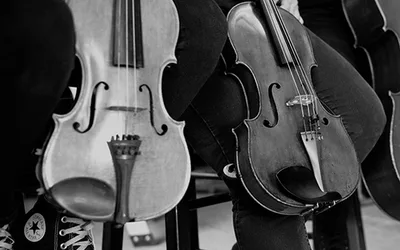
The premise sounds like a bar game, and in a sense it is. Four string players walk into a brewery. Sixteen pieces of music sit in a metaphorical jukebox. The audience picks eight of them, and nobody — not the players, not the host, not the person who built the list — knows what the evening will sound like until it happens. That is Jukebox, the Vermont Symphony Orchestra's small-room chamber series, and on Friday, November 13, 2026, it celebrates its tenth season with a stop at Burlington Beer Company, 180 Flynn Avenue.
The concert runs from 7 to 8:30 p.m., with doors at 6:30. It is general admission, all ages, and the venue is a working brewery and restaurant rather than a reserved-seat hall — a detail that has been the point of Jukebox since the beginning.
The tenth-season format is a deliberate callback. According to the event listing, this fall's series features wholly unique programs at each of its three stops, with repertoire selected on the spot each night. The pool of 16 draws from music the ensemble has played across nine years of concerts, plus some new additions to the roster. The range is wide by design: heavy hitters of the string quartet repertoire such as Beethoven and Bach, modern compositions by Jessie Montgomery and Caroline Shaw, and solos, duos, and pieces spanning the many styles and genres the Jukebox quartet has come to be known for. Eight of the sixteen get played. Every night is one of a kind.
The players are Brooke Quiggins-Saulnier and Joana Genova on violin, Stefanie Taylor on viola, and John Dunlop on cello. Composer Matt LaRocca, the VSO's artistic adviser, curates and hosts.
That hosting role is part of what distinguishes Jukebox from a standard chamber recital. In a 2017 interview with Vermont Public, VSO executive director Ben Cadwallader explained the concept: LaRocca chooses traditional and contemporary pieces across genres, then invites the chamber musicians to tell the audience how the pieces differ from their perspective as performers. The talk is not decoration. It is the bridge between a listener who wandered in for a beer and a listener who leaves having heard something they did not expect to like.
Cadwallader put the underlying argument plainly in that interview. "Chamber music ... it's supposed to be intimate," he said. "You breathe the same air as the musicians, you can see the sweat on their brow, you can see the strings vibrating. It is supposed to be an intimate experience." He added, "That's the spirit in which most of this music was originally intended." Playing in a brewery, in other words, is not a compromise of the form. It is closer to where the form started.
Jukebox began in 2016 as a co-production with ArtsRiot, the Burlington music venue, and it took hold quickly. By January 2017 the VSO was reporting that a Jukebox string quartet had drawn a standing-room-only crowd of 170. The series has sold out regularly since. By 2019, when the Burlington Free Press looked at the orchestra's audience-building efforts, the numbers had become an institutional argument: the VSO's newer initiatives, Jukebox among them, were grossing more than $150,000, roughly a tenth of the organization's $1.5 million annual budget, even as attendance at its traditional Classical Series concerts declined. The orchestra cut its Classical Series concerts from five to four a year. Jukebox, meanwhile, kept expanding.
It also kept changing shape. The series has never been content to repeat itself. A run called "Heavy Metal Strings" paired Mendelssohn with Eddie Van Halen, Nirvana, Led Zeppelin and Tool, and opened with the audience seated onstage alongside the quartet at the Paramount Theatre in Rutland before touring to Brattleboro, White River Junction, Burlington and the Bennington Museum. Dunlop, the cellist, made the case for it: "There's no question that a lot of the great rock and rollers were students of classical music in their youth." LaRocca described the arranging work as "doing a lot of choreography with pedals," and Quiggins-Saulnier ran her violin through guitar pedals to play Van Halen's 1976 solo "Eruption." "She just shreds on it," LaRocca said.
That is the sensibility the tenth season inherits. A decade in, the jukebox conceit has become a way of keeping a 250-year-old ensemble form in conversation with everything that came after it — and of handing the audience a lever.
Burlington Beer Company is at 180 Flynn Avenue, and its taproom, restaurant and barrel house now anchor a stretch of the city's South End that has become one of its more reliably interesting places to spend an evening. For a series built on the idea that chamber music belongs where people already are, it is a fitting room: open, loud enough to feel alive, and without a bad seat because there are no fixed seats at all.
The tenth-season program is not a greatest-hits revue in the usual sense, even though the hits are in the box. It is a gamble the orchestra has been taking for ten years and has evidently decided to keep taking. Eight pieces will be pulled from sixteen. The rest stay in the machine, waiting for another night, another audience, another set of hands.