


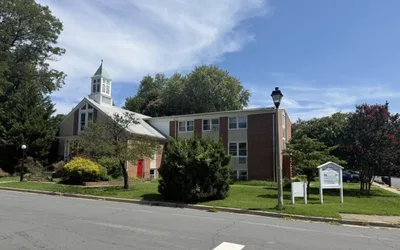
On Sunday morning, Aug. 30, at nine o'clock, the doors of a small church at the corner of South Lexington and Fifth streets in Arlington, Virginia, will open for the last time. St. John's Episcopal Church — the congregation Glencarlyn has called its "Village Church" for more than 130 years — will hold its final regular worship service, bringing to a close a story that began in 1890 with twenty farm families and a petition to a seminary in Alexandria.
The news, confirmed by the Episcopal Diocese of Virginia, has settled over the neighborhood like a long goodbye. Neighbors said they had heard the rumors of a closure and hoped they weren't true. In its September newsletter, the Village View, the Glencarlyn Civic Association mourned what it called the end of "a productive and supportive relationship" between church and community that had lasted more than thirteen decades. A final community service of thanksgiving is planned for mid-September — the civic association has been told it will likely fall on Sept. 17 in the early evening — but Aug. 30 is the closing of the regular Sunday rhythm that has pulsed through the neighborhood since before the First World War.
To understand what is being lost, you have to go back to a Glencarlyn that barely resembles the leafy, forest-bordered enclave of today. When St. John's was founded in 1890, Glencarlyn was still a tiny settlement ringed by farms, and its roughly twenty founding families were worried about something simple: there was no church close by for them and their children.
So they petitioned the Virginia Theological Seminary in Alexandria, which granted their request and began sending seminarians to Glencarlyn to lead services from the Book of Common Prayer. The church that grew up there was Episcopal in name but something broader in spirit. It was regarded as the "Village Church," gathering in residents of Glencarlyn from all religious backgrounds, a tradition the congregation carried through all its later years. Worship at first was peripatetic: services were held in a picnic pavilion in summer and in parishioners' homes when the weather turned cold. Then, in 1892, the community built its meeting house, Carlin Hall, where church services were held. St. John's worshipped there until 1910.
The congregation wanted its own building, and it raised the money the old-fashioned way. From April 1899 onward, church members and Glencarlyn residents staged plays, musicals, and ice-cream sales, slowly amassing the funds — in 1901 the church had just fifteen registered communicants and twenty-five Sunday-school students — to build a frame chapel for $1,800. That chapel, finished in 1910 at the corner of Fourth and Lexington, held about seventy people in the light of kerosene lamps bracketed along the walls, heated by a small coal furnace, furnished with an organ and a stained-glass window above the altar. Electricity arrived in 1921, and a bell tower the following year.
The little church thrived through the 1920s and 1930s, but the next decades brought near-death experiences that echo today. In the early 1940s membership fell off and St. John's was threatened with closure. The parishioners answered by publishing a weekly pamphlet of church activities and taking a risk on two more lots next to the original church. When, in 1953, the seminary stopped sending seminarians to support the parish — again threatening its existence — the congregation within a year called a priest-in-charge, the Rev. Innis Jenkins. A new building fund followed, and in July 1955 the vestry approved construction on the lots bought in 1947. Work began in May 1956, and the new $48,000 building at the corner of Fifth and Lexington — the church that still stands today — was dedicated in October 1957. An educational annex was added in 1960. In 1962, the congregation said goodbye to its first home: the original frame chapel was dismantled and transported by the Arlington Church of the Brethren to Stanardsville, Virginia, where it was used in the construction of a Brethren conference center. In 1976, St. John's finally gained status as an independent parish.
Through it all, the church remained what its own history calls the "Village Church" — a gathering place whose grounds and building hosted community events, whose pews held second- and third-generation Glencarlyn residents whose parents and grandparents had worshipped there, and whose reach eventually stretched across Arlington into Alexandria, Falls Church, Annandale, Springfield, and even Maryland. Longtime community leader Bill Pritchard wrote in the Village View that St. John's had "always been a welcoming congregation, with attendees from various religious backgrounds joining in prayer since the beginning," and that beyond serving Glencarlyn, members had long supported those in need in the wider community.
The decision to close was made by the Episcopal Diocese of Virginia, the second-largest Episcopal diocese in the United States, a body whose own roots stretch back to the founding of Jamestown in 1607. In a message to the parishioners, the Rev. Shirley Smith Graham, the diocese's canon for congregational vitality, acknowledged the end with grace: "Just as each church has a moment of beginning, so a church may also have a moment when the people of that church can no longer carry the ministry forward. When this happens, the church becomes inactive. However, the impact of the church is everlasting. The gifts of the church continue in the people who have been inspired to grow in their faith, in the memories of how the neighborhood has been nurtured by the church and its ministries, and in the items of the church that will be shared with other churches so that the ministry lives on."
What becomes of the property itself remains to be seen. The diocese has promised to keep Glencarlyn residents in the loop, and Smith Graham wrote to the civic association's leadership that "our diocese takes great care when considering the use of church properties." The association's president, Brandon Hemel, said his organization is "greatly interested in the future of the property and the continued legacy of St. John's" and hopes to be a partner in determining future uses.
For one morning, though, the business of endings will give way to the business of worship. The old congregation will gather once more — in a building completed in 1957 — to do what it has done since 1890: pray together, from the Book of Common Prayer, as the Village Church of Glencarlyn. Then the doors will close, the vestments will be packed, and the bell that rang over the neighborhood for more than a century will fall silent. But like the sanctuary that was moved to Stanardsville in 1962, the congregation's meaning will not simply vanish. It lives on in the people it shaped, in the memories of the families it married, baptized, and buried, and in the quiet, enduring fact that for 130 years, in a small Arlington village, there was always a place to go.