


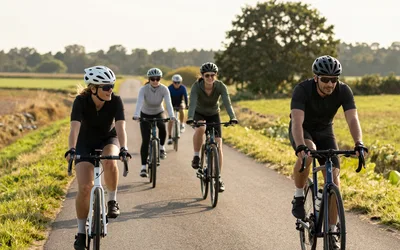
On the first Sunday of most months, a loose cluster of cyclists gathers outside Benchtop Brewing on Boissevain Avenue in West Ghent. Some are on road bikes, some on hybrids, a few on whatever was in the garage. At 2:45 p.m. they mill around; at 3:00 they roll out. An hour later they are back where they started, cooling down and, if the day calls for it, ordering something cold. The ride is called Tour de ORF, and it is one of the more quietly distinctive recurring events in Norfolk — a free, all-comers group ride that uses the Elizabeth River Trail and city bike lanes as its route, and that asks nothing of participants except that they show up.
The name is a piece of local shorthand. ORF is the airport code for Norfolk International Airport, and locals have long used it as a stand-in for the city itself. The ride is run by the Elizabeth River Trail Foundation, the nonprofit that provides planning, programming, and advocacy for the 10.5-mile trail the cyclists spend their hour on. It is not a race, not a training ride, and not a fundraiser. It is a social hour on wheels, and its organizers are explicit that all skill levels are welcome.
That openness is built into the logistics. The foundation keeps an experienced rider at the front of the group and recruits volunteers to serve as sweepers and mid-pack riders, so slower cyclists are never left behind and nobody has to worry about getting dropped in unfamiliar territory. The ride leaves from Benchtop in odd-numbered months and from Afterglow Brewing on Bowdens Ferry Road in even-numbered months, a rotation that spreads the starting point across the trail's geography. The October 4 ride, being an even month, technically falls in the Afterglow half of the calendar, though the city's own listing for that date points riders to Benchtop — a reminder that the schedule is maintained by humans and worth double-checking before clipping in. Some months the foundation adds a theme tied to the season or the time of year.
To understand why a one-hour bike ride matters here, it helps to know what the cyclists are riding over. The Elizabeth River Trail did not begin as a trail. It began as a set of idle railroad tracks.
The story starts in 1994, when a shared vision brought together four parties who did not obviously belong in the same room: the West Ghent Civic League, the Norfolk Historical Society, Norfolk Southern Corporation, and the City of Norfolk. The civic league wanted to establish Plum Point Park on a former dump site and build a walking route connecting it to West Ghent. The historical society wanted to improve access to and visibility of Fort Norfolk, the 1807 fort overlooking the river that played a key role in the War of 1812, when its position helped defend the city from the British.
The land between them had a history of its own. Atlantic City grew up around Fort Norfolk, a working waterfront district of homes, an icehouse, a knitting factory, cotton warehouses, and lumber mills. It became part of Norfolk in 1890 and got rail service in the early 1900s when the Norfolk and Western Railway extended its Atlantic City Spur along the waterfront near the fort. Then came the 1950s and wholesale urban renewal, which eradicated much of the neighborhood. By the early 1990s, Norfolk and Western had become Norfolk Southern, and the Atlantic City Spur's tracks sat unused. Fort Norfolk, remarkably, survived largely intact.
After three unsuccessful applications for federal alternative transportation funding, Norfolk Southern agreed in October 1999 to donate 3,500 feet of the old spur to the City of Norfolk for the first segment of a trail. That donation prompted the formation of the Elizabeth River Trail Committee — city staff, elected officials, and private citizens — to plan what came next.
From those 3,500 feet, the trail grew into a 10.5-mile multi-use path running between Harbor Park Stadium and the Norfolk International Terminals, following the Elizabeth River through the working waterfront. It passes ships and barges, navy vessels and tankers, and enough seabirds — cormorants, skimmers, ducks, gulls — to reward a rider who looks up. It sits within a five-minute walk of 28 neighborhoods. The foundation that now runs it is a 501(c)(3) responsible for master planning, fundraising, and activating the trail.
The foundation's ambitions have grown well past maintenance. It hosts more than 100 free and low-cost programs a year — guided historical tours, botanical walks led by Norfolk Master Gardeners, community paddles on the Elizabeth River, volunteer beautification days, and the Tour de ORF rides among them. In 2026 it added a partnership with Rollbounce Rollout, an all-wheels skating community, bringing a free monthly Vibe N' Roll event to the trail on the third Tuesday of each month, and it has explored incorporating Spinclusion adaptive rides to widen access. On April 25, 2026, the foundation marked Celebrate Trails Day by opening its new Trailside Headquarters. "The Elizabeth River Trail is more than a path — it's a shared space where community happens," Greene said in announcing the year's lineup.
That idea — the trail as shared space rather than mere infrastructure — is the through-line of the Tour de ORF. The ride is short by design. An hour is enough to cover a stretch of the trail and some city streets and still leave everyone fresh for the post-ride cool down, which is the actual point. It is the kind of event you can decide to attend that afternoon, on whatever bike you own, without having ridden in a group before. The foundation's volunteer recruitment for sweepers and mid-pack riders exists precisely so that a first-timer on a heavy hybrid is as welcome as someone in kit.
There is something fitting about the route. The cyclists roll over a corridor that once carried freight cars along the Elizabeth River, past a fort that George Washington commissioned in 1794 and that helped hold off the British, through neighborhoods that were erased and rebuilt, on a path that exists because a railroad, a civic league, a historical society, and a city decided in the 1990s that idle tracks were worth more as a place for people. On a Sunday afternoon in October, with the group strung out along the waterfront and a volunteer sweeping the back, that decision looks like a good one.