


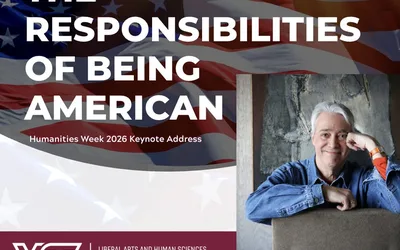
When Scott Simon steps onto the stage of the Lyric Theatre in downtown Blacksburg this fall, he will bring with him a voice that millions of Americans already know from their Saturday mornings. Simon hosts NPR's Weekend Edition Saturday, a program the Washington Post once called "the most literate, witty, moving, and just plain interesting news show on any dial." His appearance is the keynote address of Virginia Tech's annual Humanities Week, and it is free and open to the public.
The event, titled "The Responsibilities of Being American," is a discussion and Q&A session rather than a formal lecture. According to the College of Liberal Arts and Human Sciences, Simon will explore the meaning of American citizenship — a fitting subject for a year in which the university's Humanities Week takes as its theme "Legacies of 1776." As the United States approaches its 250th anniversary, the week's programming is built around the contested meanings of sovereignty, freedom, equality, and independence, asking what those founding ideals mean in an age of political polarization and rapid technological change. The keynote is scheduled for the evening of Tuesday, October 20, at 7:30 p.m.
One note for anyone planning to attend: the event listing circulated by Virginia Tech's events calendar carries a date of October 3, but the university's Humanities Week page places the keynote on Tuesday, October 20. The October 20 date is the one consistent across the university's own materials.
Simon's career is unusually wide-ranging for a broadcaster. Born in Chicago in 1952, the son of a comedian and an actress, he grew up in cities across the United States and Canada. He has reported from all fifty states, five continents, and ten wars, from El Salvador to Sarajevo to Afghanistan and Iraq. Along the way he has collected what NPR describes as every major award in broadcasting: the Peabody, the Emmy, the Columbia-DuPont, the Ohio State Award, the Robert F. Kennedy Journalism Award, and the Sidney Hillman Award, among others. He received a Presidential End Hunger Award for his coverage of the Ethiopian civil war and famine, and a special Peabody citation for his weekly essays, which the judges called "consistently thoughtful, graceful, and challenging." More recently he was given the Studs Terkel Award. Beyond radio, he has hosted television specials for PBS and the BBC and co-anchored PBS's Millennium 2000 coverage alongside the BBC.
He is also a prolific author, and that is where the book signing comes in. Simon's books have "chronicled character and characters, in war and peace, sports and art, tragedy and comedy," as his NPR biography puts it. His novel Windy City tells the story of a Chicago alderman who becomes temporary mayor after the mayor is murdered. His memoir Unforgettable grew out of a series of tweets he posted in July 2013 from his dying mother's hospital bedside — messages that spread far beyond his already large Twitter following and became a book about family, memory, and loss. He also wrote Just Getting Started with Tony Bennett, and My Cubs: A Love Story, about his lifelong devotion to the Chicago Cubs and their historic World Series victory. Copies of his books will be sold by Blacksburg Books in the Lyric lobby before the event, and Simon will be available to sign them following the Q&A — a chance for readers to meet an author whose voice they may have been hearing on the radio for most of their adult lives.
The venue itself is part of the story. The Lyric Theatre has been a fixture of Blacksburg since 1909, when it opened as a storefront silent movie house on the corner of Wilson Avenue and North Main Street. As motion pictures grew in popularity and the town expanded, the theater moved and rebuilt several times before settling into its current building on College Avenue in 1930. That house, designed in the Art Deco style by the architects Henry B. Boynton and Louis Phillippe Smithey, seated around 900 people and was among the first cinemas in Virginia equipped to show sound pictures. It thrived for decades as an independent movie house, but the arrival of corporate multiplexes and home video proved too much; the Lyric closed in 1990, its final screening reportedly The First Power.
What happened next is the reason the theater is still standing. For several years the darkened building was rented out as classroom space for Virginia Tech and served as local Democratic headquarters each fall. Then, in 1994, a group of downtown merchants and committed citizens formed a not-for-profit corporation, the Lyric Council, Inc., to restore and preserve the venue. The theater held a soft reopening in 1998 while fundraising continued, and formally reopened in 1999 after renovations that reduced the seating to 477 while preserving or recreating historic features of the original house. Today the Lyric operates as a 501(c)(3) nonprofit whose mission is to enhance community participation in arts and culture — showing films, hosting live programs, and partnering with community groups. It has, by its own account, been "the heart of Blacksburg" for more than a century, and it is currently raising funds for another round of upkeep, from worn seats and shredded wall tapestries to a lobby refresh.
That a landmark rescued by its own community should host a talk on the responsibilities of citizenship has a certain symmetry. The pairing of a nationally known broadcaster with a small-town theater saved by volunteers is exactly the kind of civic moment Humanities Week seems designed to create. The event is free, general admission, and open to the public; those with accessibility questions can contact Angeli Yates at Virginia Tech's College of Liberal Arts and Human Sciences.
For a town that has kept its 1930 movie palace alive through two market upheavals, an evening with the host of Weekend Edition Saturday is less an imported spectacle than a homecoming of sorts — a reminder that the humanities, like the Lyric itself, endure because people choose to keep them.