


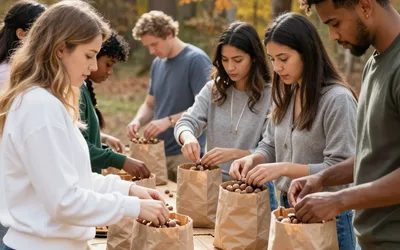
The instructions are almost comically specific. Acorns must arrive in mesh bags, doubled brown paper bags, or, as the state puts it, "anything breathable." Plastic is forbidden. One species per bag. Every donation must be tagged with the date and place the nuts were gathered, and if you can't name the tree, you're welcome to drop a leaf or a twig in the bag so someone else can. Black walnuts are accepted hulled or unhulled. And then, sometime between 8:30 in the morning and 5 in the afternoon, Monday through Friday, you carry your labeled sack of seeds to Suite 131 at 750 Miller Drive in Leesburg and hand over the raw material of a forest that won't exist for decades.
It is, on its face, an odd errand. But it is also one of the more quietly consequential civic rituals in Virginia, and it has been running long enough to have its own folklore.
The collection is run by the Virginia Department of Forestry, which gathers acorns and nuts each fall and plants them at its Augusta Nursery in Crimora, in the Shenandoah Valley. The nursery, which has been producing seedlings since 1966, grows the seeds into hardwood seedlings over the following year. Those seedlings are then sold to Virginia's forestland owners and planted across the state. The logic behind the whole enterprise is genetic: a tree grown from a seed that fell in Virginia soil is a tree suited to Virginia's soils and climate, better positioned to thrive than stock trucked in from somewhere else.
The department has been growing seedlings for Virginia landowners for more than a century, and its cultural practices rest on more than sixty years of research into quality production. The acorn drive is the front end of that supply chain, and it depends entirely on the public. As State Forester Rob Farrell put it in a department release, "Our annual fall collection campaign helps the Virginia Department of Forestry grow our future forests. Your donations help our nurseries grow trees with genetics that thrive when later planted in the commonwealth's forests and communities. Collecting can be educational and provides a fun group activity. Help us ensure our future forests are here for generations to come."
What makes the program necessary is a fact of tree biology that most people never think about. Certain nuts are difficult to find regionally, and availability swings from year to year. One species of oak in one part of Virginia may produce almost nothing in a given autumn while another species nearby is dropping heavily. The department can't simply order what it needs; it has to put out a call and hope landowners answer. That variability is precisely why the agency asks the public to collect, and why it publishes a list of species it is especially hungry for. In recent years that wish list has included black oak, black walnut, chestnut oak, white oak, and bur oak. All donations are welcome, but those are the ones that make nursery managers sit up.
The collection has grown into something bigger than a bureaucratic supply run. The department reports that in 2025, Virginians collected and planted thirteen tons of acorns, chestnuts, and walnuts. Thirteen tons of seeds, gathered by hand, one bag at a time.
That figure starts to make sense when you learn about people like Ortmeier, an Arlington native and retiree who has become something of a legend inside the department. According to reporting on the program, he has personally collected more than eight thousand pounds of acorns for Virginia — a number that strains belief until you picture a retired man spending his autumns under oak trees with a rake and a stack of breathable bags. His dedication has earned him a measure of notoriety within the agency that runs the annual drive, which is to say that in a program staffed by foresters, he is the one they talk about.
This year the department changed how it handles the logistics. For 2026 it consolidated its drop-off locations, asking donors to consult a published list to find the site nearest them rather than assuming every office will take nuts. The Leesburg site at 750 Miller Drive is one of those designated locations, operating through October 8. The statewide collection window runs from September 8 to October 11, so the Loudoun County site closes a few days ahead of the final deadline — worth knowing if you're the sort of person who gathers acorns on the last possible weekend.
The mechanics of donating are simple enough that a child can manage them, which is arguably the point. Bag them. Tag them. Drop them off. Keep the species separate. Don't use plastic, because seeds that can't breathe will mold before they ever reach a nursery bed. If you can't identify the tree, include a leaf. The department even publishes an identification guide for people who find themselves standing in a yard full of fallen nuts, squinting upward and wondering what, exactly, they're looking at.
There is something appealing about the scale of the thing. A single acorn is a trivial object, the kind of litter that collects in gutters and gets raked off lawns and thrown away. Most of the nuts that fall in developed areas would never become trees; they land on pavement, get mowed into turf, or rot in a bag by the curb. The collection program exists to intercept a fraction of that waste and route it somewhere it can actually become something. The department's own framing is blunt about it: many of the nuts falling in developed areas would otherwise never grow into trees, which is what makes public donations matter.
And the payoff is slow. A donated acorn goes into a nursery bed, germinates, spends a year or more as a seedling, gets lifted and sold and planted, and then spends decades becoming a tree. The person who bagged it may never see the result. That's the deal the program offers, and thousands of Virginians take it every year.
For anyone in Loudoun County who wants in, the window is finite. Through October 8, on weekdays between 8:30 a.m. and 5 p.m., Suite 131 at 750 Miller Drive in Leesburg will accept acorns in breathable bags and black walnuts with or without their hulls, each bag labeled with the species and the date and location of collection. The department's collection guide lays out the rest of the details. After that, the site goes quiet until next fall, when the oaks drop again and the bags come out.