


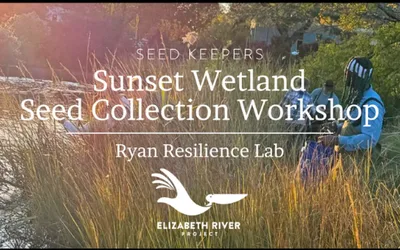
On the evening of October 15, 2026, a small group will gather at 4610 Colley Avenue in Norfolk, walk out toward the water, and spend an hour doing something that looks almost like nothing: plucking ripe seeds from marsh grass as the light goes amber over the Elizabeth River.
It is, in fact, one of the more consequential hours a person can spend on this riverbank. The Sunset Wetlands Seed Collection Workshop, run by the Elizabeth River Project, sends participants into the wetlands to collect and observe Spartina alterniflora — smooth cordgrass — along with other halophytes, the salt-loving plants that hold tidal marshes together. The seeds gathered that evening will not be a souvenir. They will go into a community native seed library and, from there, into restoration plantings along local shorelines.
The workshop belongs to a program called Seed Keepers of the Elizabeth River, and the reason it exists is a problem most people never think about: where restoration plants come from.
Luísa Black Ellis, the nonprofit's director of resilience and community engagement, explained the issue to WHRO in 2025. For years, many of the plants used in local restoration work were imported from elsewhere — Florida, Delaware, the Midwest. "The whole reason to plant native plants is because they're adapted to our climate," Ellis said. "They're adapted to our ecology. So when we're planting these native plants from these faraway places, we don't necessarily know that they are actually as climate resilient as we're hoping."
Worse, much of the imported marsh grass was genetically identical. "So if just one insect or disease comes through, that one set of genetics is vulnerable," Ellis said. "That means the whole wetlands collapse because they're all coming from that same single genetic stock."
The fix is local genotype seed — seed grown from plants that have already survived this river's particular mix of salinity, heat, storm surge, and pollution. To figure out how best to propagate those species, the Elizabeth River Project partnered with Old Dominion University's Wetland Plant & Restoration Lab, working with researchers Dr. Taylor Sloey and Dr. Erik Yando and research fellow Eric Liu. The Seed Keepers program is funded by a donation from the JP Doherty Foundation.
The seed library itself opened in spring 2025, and it is a charmingly modest thing: a small vintage catalog cabinet tucked inside an office at the Ryan Resilience Lab, holding thousands of seeds free for residents, businesses, and organizations to borrow, plant, and return in kind. Most seed libraries in the region focus on garden vegetables and flowers. This one leans hard toward marsh grasses — the unglamorous workhorses of a living shoreline.
That focus matters because of what Spartina alterniflora actually does. Smooth cordgrass is the dominant salt marsh grass along the Atlantic and Gulf coasts, a perennial that thrives in the intertidal zone where few other plants can survive being flooded twice a day by salt water. Its dense root mats bind mud in place, blunting wave energy and slowing erosion; its stems trap sediment and build marsh elevation, which is one of the few natural defenses a coastal city has against rising seas. It is used extensively in coastal reclamation and habitat restoration for exactly these reasons. In a region where, as Elizabeth River Project executive director Marjorie Mayfield Jackson has put it, sea level rise "threatens to drown more than 90% of Coastal Virginia wetlands," a plant that can grow the marsh upward is not a decorative species. It is infrastructure.
This year's donated seed will supply a large-scale spring planting at Knitting Mill Creek Park, which means an hour of seed-picking on a Thursday evening in October translates directly into new marsh grass in the ground the following spring. Participants will also learn how to process and store seed properly, so the library stays stocked.
The setting for all this is itself part of the story. The Ryan Resilience Lab, a 6,500-square-foot building that opened on Colley Avenue on June 1, 2024, is designed as a working demonstration of how to live in an urban floodplain. It sits ten feet above the ground, generates its own power with solar arrays and battery backup, captures rainwater, and is built around a "planned retreat" — the deliberate understanding that the river will eventually retake the site as waters rise. Architecture students from Hampton University researched floodplain structures around the world during the design phase, and Norfolk's Work Program Architects turned those findings into the finished building. The lab anchors a new EcoDistrict of more than fifteen businesses dedicated to restoring Knitting Mill Creek by cutting pollution and reopening public access to the water.
None of this would exist without a decision made in 1991. That year, Marjorie Mayfield Jackson — then a newspaper reporter who could see the Elizabeth River from her back porch — quit her career to try to save it. The river was, by any measure, a disaster: unswimmable, heavily contaminated with creosote and industrial chemicals left behind by the shipping trade that dominates the regional economy, its remaining aquatic life developing cancerous lesions. Mayfield Jackson took a part-time waitressing job to support herself while she and a small team began the restoration effort that became the Elizabeth River Project.
What distinguished the project was its method. Rather than litigating, it brought together groups that were normally adversaries — industry, government, citizens, scientists — to find solutions that served both the ecology and the economy of the river. Over three decades the river has measurably recovered, wildlife has returned, and the organization has planted wetlands and built oyster reefs across the watershed, including in the Lafayette River, where it and the Chesapeake Bay Foundation convened a hundred people to set restoration goals. The nonprofit also pioneered "oyster bergs," small citizen-accessible reefs, with the Lafayette Wetlands Partnership and SKW Constructors.
Mayfield Jackson once described the shift she has watched happen. "From my perspective, there's been a dramatic change in how people perceive the river and how much they care about it," she said. "People are enthralled with it. They never tell me it's dead anymore. They just want to know what they can do to help."
The Sunset Wetlands Seed Collection Workshop is one concrete answer to that question. It is free, it is open to anyone who shows up at the Colley Avenue site, and it asks nothing more of a participant than an hour, a willingness to get their hands dirty, and an interest in the unglamorous mechanics of how a river comes back. The seeds are small. The marsh they build is not.