


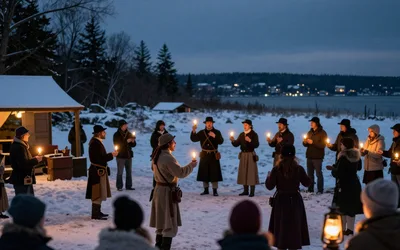
The first thing to understand about the Candlelight Tour at Fort Nisqually is that nobody is going to acknowledge you. You walk into the fort after dark, past campfires and candle lanterns, and the people you meet are living in 1857. They are fur trappers and Scottish and French Canadian laborers, blacksmiths and American settler families, and they are going about their evening as if you were not there at all. You are not an audience. You are an eavesdropper.
The event returns to the Fort Nisqually Living History Museum in Tacoma's Point Defiance Park on October 2 and 3, 2026, with tours running between 6 and 10 p.m. each night. More than a hundred historical interpreters take part, making it one of the larger living-history productions in the region. Guests move through the grounds in small groups while songs, dances, and games unfold around them, all of it lit by firelight and candle flame rather than electricity.
What gives the evening its spine is a specific historical moment. In 1857, the fort's residents were celebrating the marriage of Letitia Work and Edward Huggins, the fort clerk. The Candlelight Tour recreates the reception and dance that followed the wedding, which took place at Fort Nisqually on October 21, 1857. It is a canny choice of year and occasion. A wedding is a gathering, and a gathering lets the museum populate an entire fort with people who have a reason to be singing, dancing, and playing games together after sundown.
Edward Huggins is a genuinely interesting figure to build an evening around. Born in London on June 10, 1832, he signed on with the Hudson's Bay Company at fifteen and was sent to the Columbia Department in 1849, arriving at Fort Nisqually by way of Fort Victoria on April 13, 1850. He served the company as a clerk for twenty-two years and became proprietor of Fort Nisqually from 1859 to 1869. When the fort closed, he became an American citizen, claimed the land the fort had stood on, and established a farm. He taught school, served on the Pierce County Board of Commissioners from 1876 to 1880 — including a term as chairman — and was later elected county auditor. He also became a historian of the region, and the museum today holds a collection of items related to him. In other words, the young man at the center of the 1857 wedding scene grew into one of the people most responsible for remembering what the place had been.
The fort itself has a longer and stranger story than its tidy palisade suggests. Fort Nisqually was established by the Hudson's Bay Company in 1833 as a fur trading outpost, the first globally connected settlement on Puget Sound. The company had first set up a temporary post called Nisqually House near the mouth of Sequalitchew Creek in the spring of 1833, then moved inland to a more permanent station later that year, and in 1843 relocated again, a mile further inland, to a site on the south bank of the creek. That third post is the one historians call the 1843 Fort Nisqually, and from 1843 to 1870 it was a busy frontier enterprise — a business, a multicultural community, and a meeting place for Hudson's Bay Company employees, Native Americans, and American settlers.
As the fur trade declined, the company needed another source of income. The Puget Sound Agricultural Company, with roughly 160,000 acres, grew crops and raised livestock in the region from 1839 to 1869. The fort was always a multicultural community, staffed by people from different ethnic groups who worked for the HBC and the agricultural company. By the late 1850s, the era the Candlelight Tour portrays, American settlements were closing in around a British outpost in what was becoming Washington Territory. In 1869 the Hudson's Bay Company sold its holdings to the United States government and withdrew.
The fort you walk through on a Candlelight Tour is not, strictly speaking, the original structure in its original place. The Fort Nisqually Granary and the Factor's House were moved from the original site to Point Defiance Park, and the fort was reconstructed in the 1930s. That effort was a genuine community project: the Works Progress Administration and local work relief programs came together to relocate and rebuild it. The Granary, moved along with the Factor's House, is a U.S. National Historic Landmark, designated on April 15, 1970. A 2017 exhibit at the museum, "Saving Fort Nisqually," looked back at that 1930s restoration, displaying the original reconstruction blueprints, a log book signed by early visitors, and a commemorative Native American paddle decorated and dated with the new museum's original opening date in 1934.
That layered history is part of what makes the Candlelight Tour unusual. You are standing in a 1930s reconstruction of an 1840s fort, watching people perform 1857, by the light of actual fire. The illusion depends on what the museum leaves out as much as what it puts in. There is no electricity in the scene, no modern signage intruding on the mood, and no fourth wall. The interpreters stay in character and in their own century, which is why the event's own description says the people of the past "won't be aware of their 21st century visitors."
The logistics are worth knowing before you go, because this is a popular event that tends to sell out. Tours last about an hour. Guests begin at the Point Defiance Zoo parking lot, where a shuttle carries them to the fort; your ticket time is the shuttle's departure time, so arriving at least fifteen minutes early to check in is advised. Adult admission is $26, and tickets for ages 4 to 17 are $19. Children younger than 4 may attend free but must ride on an adult's lap on the shuttle. Advance purchase is required, and all ticket sales are final, with no refunds or exchanges. Several early departures on both nights have sold out in past years.
The tour happens rain or shine, over uneven ground, with visibility that gets steadily worse as the night deepens. Dress for the weather. Umbrellas, flashlights, photography, and strollers are not permitted — a set of rules that makes sense once you understand the premise. A flashlight or a camera flash would break the spell the interpreters are working to build. Anyone needing accessibility accommodations can call Fort Nisqually at 253-404-3970, and tour groups are asked to call the same number for assistance.
There is something quietly fitting about the whole arrangement. Fort Nisqually spent its working life as a place where people from very different backgrounds — British traders, Scottish and French Canadian laborers, Hawaiian and Iroquois workers, Native people, and American settlers — lived and worked in close quarters at the edge of empire. The Candlelight Tour asks visitors to move through that world the way a stranger might have: quietly, at night, catching fragments of conversation and music, understanding only part of what they see. For a couple of hours in October, the fort goes back to being what it always was — a place full of other people's lives, briefly overheard.