


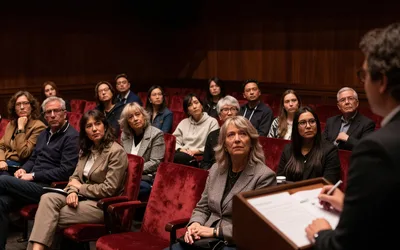
The question in the title is not a rhetorical flourish. In the 1970s, '80s, and '90s, the Pacific Northwest was the origin point for some of the country's worst serial killers, and true crime author Rebecca Morris wants to talk about why. On Wednesday, October 21, 2026, she brings "What's Up with the Pacific Northwest and Serial Killers?" to the Spanish Ballroom at McMenamins Elks Temple, 565 Broadway in Tacoma.
The talk is part of McMenamins' History Pub series, a long-running program that the company describes as being "like being back in the classroom -- except this time you get to settle into comfortable seats and enjoy a drink or two with dinner while you listen and learn." The series is open to anyone interested in Pacific Northwest history and is often co-sponsored by local or state historical and civic organizations; the Washington State Historical Society has partnered on Tacoma History Pub events in the past. History Pub nights at Elks Temple also come with a 15 percent discount on hotel stays for attendees who show their ticket at check-in, and the event is eligible for a History Pub stamp.
The subject matter is heavy, and the venue says so plainly: the talk discusses violence and is not appropriate for young children. Audience discretion is advised, though the event is otherwise open to all ages.
Morris's framing is a set of hypotheses rather than a single answer. Could it be the rain and the dark skies? The possibly too convenient I-5 corridor running from California to Canada? Or the Tacoma smelters that once emptied tons of lead emissions into the air? She names Ted Bundy, Gary Ridgway, Robert Yates, and David Berkowitz among the killers she'll discuss, and promises to look at their commonalities, their differences, the justice sought for victims, and the unsolved mysteries of the region.
That last item is not an abstraction for Morris. Her book "Ted and Ann: The Mystery of a Missing Child and Her Neighbor Ted Bundy" examines the 1961 disappearance of eight-year-old Ann Marie Burr from her Tacoma neighborhood -- and the question of whether Bundy, who lived nearby as a teenager, may have been responsible. Burr's body was never found. The book drew praise from Ann Rule, the bestselling true crime author, and from Gregg Olsen. Morris has said the case is the only one she knows of that is treated in a full-length book, and she has appeared on ABC's "20/20" discussing Bundy's psyche.
Morris's connection to the region runs deeper than the Bundy case. A native Oregonian, she worked in radio and television news in New York City, Portland, and Seattle, and her reporting has appeared in The Seattle Times, The Oregonian, People, Entertainment Weekly, New York Newsday, and American Theatre, among other publications. Her books include "A Murder in My Hometown," about the 1967 killing of seventeen-year-old Dick Kitchel in Corvallis, Oregon -- a case she returned to as a classmate of the victim nearly fifty years later -- as well as "Boy Missing: The Search for Kyron Horman," "A Killing in Amish Country," "If I Can't Have You," "Notorious USA," and "Bad Apples." She lives in Seattle.
The venue itself carries a certain amount of atmosphere for a talk about the darker side of local history. The Elks Temple was built in 1916 in the second Renaissance Revival style, designed by É. Frère Champney, a graduate of the École des Beaux-Arts in Paris, and is listed on the National Register of Historic Places. The Tacoma Elks Lodge was established in 1890, twenty-two years after the national Elks organization formed in New York City. After a long decline, McMenamins restored and reimagined the building as a seven-story hotel, brewery, and entertainment complex, reopening it with a peal of bagpipes. The Spanish Ballroom, reached by the Spanish Steps on the second floor, is the grand space at its heart, with Doc's, a third-floor games bar, overlooking it from above.
For anyone who has followed the region's true crime history -- or who has driven the I-5 corridor and wondered -- the evening offers a chance to hear a journalist who has spent years on these cases lay out the theories and the evidence side by side. It is a talk, not a tour of gore, and Morris's stated interest is in the victims and the pursuit of justice as much as in the killers themselves. But the questions she raises are the uncomfortable ones: what about this place, in those decades, made it possible?