


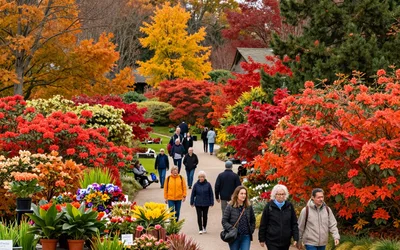
Most people who know the Rhododendron Species Botanical Garden know it in May. That is when the woodland between Seattle and Tacoma turns into a wall of trusses — pinks, creams, scarlets, the occasional sulfurous yellow — and the garden's reputation as home to the largest collection of rhododendron species on earth feels self-evident. November is a different garden. And that, more or less, is the point of the Fall Foliage Festival.
The festival returns Saturday and Sunday, Nov. 7–8, 2026, from 10 a.m. to 4 p.m. each day, at 2525 S 336th St in Federal Way. Admission is free and open to the public. Visitors can wander the garden's 22 acres of woodland paths, discover the garden's fall color, and shop for specialty plants.
What distinguishes this from a generic harvest fair is the sale. Specialty plant vendors set up with unusual plants, garden-worthy specimens, and collector favorites — the sort of material that sends a certain kind of gardener home with a muddy trunk and a plant list annotated in three colors. The garden's own event page also promises a curated selection of art and handmade goods inspired by nature and the outdoors. The nursery sells many of the plants visitors see growing in the garden itself, which makes the shopping a kind of living catalog.
And the fall color here is not only what you'd expect. In a staff blog post, horticulturist and assistant curator Will Clausen highlighted deciduous conifers — plants that spend the summer masquerading as ordinary pines, firs, and redwoods, complete with cones and needle-like foliage, before turning gold and dropping their needles in autumn. They are among the garden's more surprising seasonal contributors.
The garden's origins are stranger and more determined than its serene setting suggests. The Rhododendron Species Foundation was incorporated in 1964 by Pacific Northwest members of the American Rhododendron Society, driven by frustration: too many plants sold as "species" were grown from open-pollinated seed with no safeguard against hybridization, and the results were often poor. At an international rhododendron conference in Portland in 1961, American attendees had been dazzled by photographs of species plants far finer than anything then available in the United States. Drs. Milton Walker and Carl Phetteplace formed a Species Project Committee, with the encouragement of then-ARS president Harold Clarke, and set out to find and acquire the best forms of selected species.
Walker's part of the story reads like a caper. In March 1964 he traveled to England to see whether cuttings of the finest species rhododendrons — many from original wild plants — could be obtained from British gardens. He visited Windsor Great Park, Wakehurst, Leonardslee, and the great Cornish gardens including Caerhays, and in September wrote to those and others, among them Brodick, Wisley, Corsock, Leggygowan in Northern Ireland, Glenarn, Logan House, the Younger Botanic Garden of Benmore, Stronachullin, and the Royal Botanic Garden in Edinburgh. Then came the obstacle: American import rules meant the cuttings could not come directly from Europe. Canada, with what the foundation's history calls "extraordinary flexibility" on the part of the agriculture department and customs, could take them. So Walker contacted Mary Grieg, owner of the Royston Nursery on Vancouver Island, and the material was imported and propagated there before making its way south — no longer European cuttings, but Canadian-grown plants.
Walker came home with more than plant material. He brought back friendships among British plantsmen and, in the words of the foundation's account, "the concept of the RSF." By June 1964 the foundation had a board. The collection, meanwhile, led a nomadic early life before landing at its permanent home: 24 acres offered at no cost by the Weyerhaeuser Company on its corporate headquarters campus in Federal Way in 1974, with the collection relocated the following year.
What grew from those cuttings is now a living museum. Curator Steve Hootman was already known for traveling to remote corners of the globe to gather seed. The garden's companion plantings — Himalayan blue poppies, camellias, magnolias, Japanese maples — round out a collection that functions as both public pleasure ground and scientific resource, distributing seed and pollen and publishing a twice-yearly catalog of rare plants.
Conservation has been part of the mission since the beginning, and it has only grown more urgent as rhododendron habitat has been destroyed in many parts of the world. A fall festival at a garden built to safeguard that diversity is a quieter proposition than a spring bloom tour, but it may be the more instructive visit: the season when the garden's structure, bark, and deciduous companions take over from the flowers, and when the plants for sale are the ones that will actually go in the ground.
Practical notes: the garden sits between Seattle and Tacoma, at 2525 S 336th St in Federal Way. Hours are 10 a.m. to 4 p.m. both days. Admission is free; bring a plant list, and leave room in the car.