


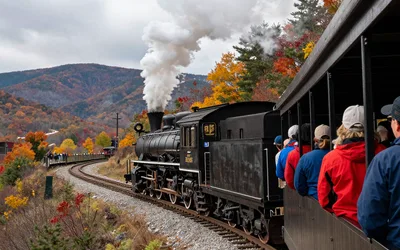
The boarding call goes out from a two-story brick depot on Railroad Avenue in Elkins, West Virginia, a building the Western Maryland Railway put up in 1908 when this mountain town was a hub for coal and lumber. The depot is Romanesque Revival, with a broad hip roof and timber brackets, and it still does the job it was built for: it boards passengers. On October 4, 2026, at 11 a.m., the New Tygart Flyer pulls out of it for a four-hour, 46-mile round trip into country that has no road to it.
The train is run by the Durbin and Greenbrier Valley Railroad, a heritage and freight line headquartered in Elkins that has operated since 1997 and today also runs the historic geared steam locomotives of the Cass Scenic Railroad. The New Tygart Flyer is its wilderness excursion, and the description the railroad gives it reads like a list of things a train should not be able to do comfortably: mountain grades, an S-curve tunnel, a high bridge, and miles of unspoiled mountain views. Vintage diesel locomotives do the climbing, hauling climate-controlled passenger coaches along the cascading Shavers Fork of the Cheat River, deep into the Allegheny Mountains of the Monongahela National Forest.
The destination is the High Falls of Cheat, and the name is a small lie that locals have long since stopped correcting. The falls are not on the Cheat proper but on the Shavers Fork, its headwater branch. They sit at more than 2,800 feet above sea level, one of the largest and loftiest waterfalls in West Virginia, dropping over a horseshoe bend of rock that is 150 feet wide and 18 feet high. The water empties into a clear pool before tumbling down the mountain to become, eventually, the Cheat River.
What makes the trip unusual is not just the waterfall but how you get to it. For many years, the High Falls could only be reached by trail — a U.S. Forest Service path that climbs through old-growth forest and groves of towering hemlock as it winds through a saddle on Shavers Mountain. Hikers still use it. But the railroad's route along the river puts passengers at the falls without a single step of elevation gain, which is why the excursion has earned a reputation as one of the most relaxing mountain wilderness rides in the region. A cold-cut lunch is included in the ticket price and served onboard on the way out.
This is a landscape that exists because of railroads, and the rails the Flyer uses are not a tourist contrivance laid over a scenic valley. Elkins itself was called Leadsville until the West Virginia Central arrived in 1889; the town was formally laid out by Senator Henry Gassaway Davis and Stephen Benton Elkins, and it was incorporated in 1890, less than five years after their first venture into the area. The West Virginia Central and Pittsburg Railroad was built from Cumberland, Maryland, to Elkins between 1880 and 1889. Elkins became the headquarters of the Western Maryland Railway's Elkins Division, with a yard, roundhouse, wash rack and depot, and every branch in the division came home to that yard — north over the Black Fork Grade toward Cumberland, east on the Belington line to the Baltimore & Ohio, south on the 46.9-mile Durbin Branch to the Chesapeake & Ohio, and west on the Greenbrier, Cheat & Elk toward Webster Springs. The curves on every line out of town were the reason the yard's ordinary diesel was a four-axle Alco.
The New Tygart Flyer runs on a piece of that inheritance. The route follows the Shavers Fork up through Bemis and the surrounding small communities, climbing grades that were engineered for coal and timber rather than for sightseeing, crossing a high bridge over the river and threading an S-curve tunnel. Passengers who have written about the trip describe the roar of the Shavers Fork rising to meet the train as it climbs, and the sudden quiet of the forest at the top.
Fall is the season the railroad leans into hardest. The Durbin and Greenbrier Valley's foliage runs have drawn notice from Southern Living, Arlington Magazine and Travel + Leisure, and the railroad raises its rates by $10 starting September 16, 2026, for the fall season. On the New Tygart Flyer, adult tickets for ages 12 to 64 are $85; seniors 65 and over pay $83; military and veterans with valid ID pay $81; children ages 4 to 11 pay $65; and infants three and under ride free but still require a ticket. For $100, passengers 12 and older can upgrade to Parlor Service, which seats them at a private table with adult beverages and an upgraded lunch. Children under 12 are not permitted in the Parlor Car. The train is not wheelchair or handicap accessible, though restrooms are available onboard.
It is worth being precise about what kind of ticket this is. Seating is assigned by fare class rather than general admission — coach passengers buy a ticket in a particular category, and Parlor Service buys a specific table — so anyone planning to go should treat this as a reserved, ticketed excursion and book ahead rather than expecting to walk up and find a seat. The train boards at 315 Railroad Avenue in Elkins, and the 2026 season runs April through early November.
There is a particular pleasure in arriving at a waterfall by rail, and the people who have done it tend to mention the same thing: the falls are not the whole point. The point is the four hours of mountain country on either side of them, country that the coal and lumber crews of the 1880s opened up and that the tourists of the 2020s now ride through at a walking pace, lunch in hand, with nothing to do but watch the river come down out of the mountains.