


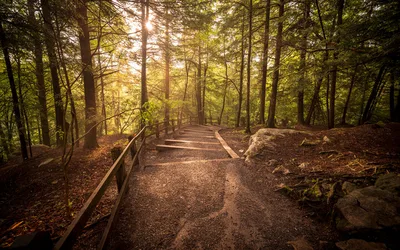
On a Sunday morning in mid-October, when the ridges south of Charleston are usually at their loudest with color, a small group will gather at Kanawha State Forest and walk into the woods with a naturalist to look at something most hikers step over without a second glance: dead wood.
The WonderFall Hike, set for October 18, 2026, at 11 a.m., is led by forest naturalist Jess Blalock along the CCC Snipe Trail. The premise is deceptively simple. Participants will examine how microhabitats — the small, distinct pockets of conditions that form within a larger landscape — benefit the forest as a whole. For the younger walkers, there is a structured investigation drawn from Project Learning Tree, the environmental education program, in which Junior Naturalists study the organisms that live on, in, under, and around fallen logs and trace how their activity recycles nutrients back into the forest soil. Adults get their own curriculum: learning to identify common wood-loving saprobic fungi, the decomposers that feed on dead organic matter, including which species are medicinal or edible.
The event is free and open to the public, and it is one stop on a broader seasonal series. WonderFALL Walks are guided hikes staged each October at six West Virginia state parks and forests — Cass Scenic Railroad, North Bend, Tygart Lake, Blackwater Falls, Cacapon Resort, and Kanawha State Forest — timed to coincide with the state's prime fall color. Participants who complete a walk with a naturalist receive a special WonderFALL patch, one of four collectible hike patches the park system offers across the year, alongside the First Day (January 1), Green Day (March), and National Trails Day (June) walks. The Junior Naturalist component also makes participants eligible for that program's patch or pin. Organizers recommend sturdy shoes and tick repellent; the hike is rated easy.
What makes the route itself worth the trip is its history. The CCC Snipe Trail is a paved interpretive path that follows the course of a water line laid by the Civilian Conservation Corps in the 1930s to serve Camp Kanawha. Along its roughly one-mile stretch, hikers pass an abandoned and sealed coal mine — a reminder of what this land was before it became a forest.
That transformation is one of the more remarkable New Deal stories in West Virginia. Before the state acquired it, the site on the headwaters of Davis Creek, about seven miles south of Charleston, had been extensively logged and mined. The state acquired 6,705 acres in 1937. On April 6, 1938, the CCC established Camp Kanawha in the forest, and over the next four years its workers remade the exhausted landscape. They tore out abandoned houses, coal tipples, and other disused structures, and built roads, a superintendent's residence, an office, a maintenance building, and picnic shelters. The residence and shelters were raised from native chestnut logs felled by the recent blight — the great chestnut die-off that had swept the Appalachians — turning a catastrophe into building material. The CCC also dammed Davis Creek to create a small lake. Camp Kanawha closed on June 30, 1942, as World War II drew the corps away.
The forest grew into something worth protecting. A 1966 survey counted 574 wildflower species across 292 genera and 93 families, along with about 65 tree species. It provides nesting habitat for 19 species of wood warblers, a draw for birders who travel from as far as Canada. The Kanawha State Forest Historic District, including the CCC-built structures, was added to the National Register of Historic Places in 1993. The forest now spans roughly 9,300 acres and offers more than 60 miles of multi-use trails, a swimming pool, stables, picnic areas, playgrounds, a shooting range, and a 45-site campground.
It is also a landscape that keeps changing. The forest sits on the edge of modern coal-mining pressure; residents living nearby have raised concerns about mountaintop mining proposed along its boundary and the flooding risk that could follow. Against that backdrop, a hike about fallen logs and the fungi that break them down reads less like a nature stroll and more like a lesson in how forests heal — and how much work, human and otherwise, it takes to keep them whole.
For the October walk, the takeaway is meant to be tangible. A rotting log, the event's framing suggests, is not debris but a neighborhood: a microhabitat crowded with organisms doing the quiet labor of turning dead matter back into soil. Blalock's route, laid along a line the CCC dug nearly ninety years ago, is a fitting place to notice it. The trail the Depression-era crews built to carry water now carries hikers past the evidence of what the forest used to be, and what it has become since.
Those planning to attend should bring water and snacks, dress for the weather, and wear sturdy walking shoes or boots. The hike is free, and the patch — like the fall color — is available while supplies last.