


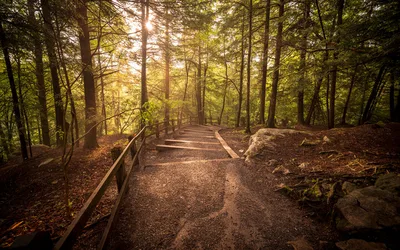
Every October, West Virginia's state parks hand out patches for fall hikes. Most of them are about leaves. The one at Pipestem Resort State Park on October 24, 2026, is about what was there before the leaves — and before the park.
The WonderFall Hike begins at 10 a.m. at Park Headquarters. A naturalist leads a walk of about a mile, roughly an hour and a half, along the road and into the woods, looking for evidence of Pipestem's pre-park history. Historic photographs and stories are shared along the way, and the group learns about the plants it passes and how those plants tie into the same history. Participants who want to keep going can walk a little farther to a cemetery where some of the people whose stories are told on the hike are buried. The program is free and open to the public, and those who come along receive a special WonderFall patch.
That a state park naturalist can lead a history walk at all is the interesting part. Pipestem as a resort — lodges, golf, a tramway down into the Bluestone River Gorge — is a creation of the 1960s and after. Pipestem as a place is much older, and the park was built on top of it.
Before there was a park, there was a community called Pipestem, with its own post office and school, according to the West Virginia Encyclopedia. The name itself comes from a plant. The park was named for the native pipestem plant, also known as meadowsweet, whose hollowed-out twigs were used by Indians and early pioneers as stems for tobacco pipes, according to the West Virginia Encyclopedia. The plant is common to the vicinity of the park and in other parts of West Virginia.
Development of the park began in the 1960s. The West Virginia Encyclopedia records that 4,027 acres were purchased from 56 individual landowners, some of whom contested the terms of settlement. The park opened officially on Memorial Day 1970.
Credit for the park's existence is generally given to John E. Faulconer (1903–1981), a Hinton native, columnist for the Beckley Post-Herald and owner of the Hinton Daily News, described by the West Virginia and Regional History Center as the founder of Pipestem State Park and one of the state's most esteemed historians. A New York Times report from October 1963, when Hinton was reeling from the loss of some 800 railroad jobs, quoted Faulconer, the newspaper publisher, describing the town's sudden euphoria: "The morale of the people has had an overnight transformation." The park was part of that transformation.
Life in the hollows before the park was not always tidy. According to the Athens We Knew account, moonshining was a way of life for some in Summers County in the years before land acquisition, and two active stills were found and shut down during development. One of them is on display at the park; the location of the other can be seen from the aerial tram, under a large rock overhang beside a mountain stream about halfway up the mountain.
That is the kind of thing the WonderFall Hike is after: the still, the cellar hole, the old roadbed, the cemetery on the ridge — the physical traces that survive when a community becomes a park. The hike's subtitle, "Country Roads," is a nod to the routes people walked and drove before the land was assembled, and the walk follows a road before it turns into woods.
The timing is deliberate. Late October is peak foliage in southern West Virginia, and the WonderFall series is the parks system's annual invitation to get outside for the color. Pipestem sits on the east rim of the Bluestone River Gorge, with elevation running from 2,932 feet at Pipestem Knob down to 1,550 feet at the river, so the walk has views as well as history. The naturalist-led format means the hike is as much a story hour as a tramp through the leaves.
Practical details are simple. Meet at Park Headquarters at 10 a.m. on Saturday, October 24, 2026. The walk is about a mile and takes around an hour and a half, with an optional extension to the cemetery. Dress for the weather — the event listing notes the program is free and open to the public, and the park asks participants to be prepared for conditions. For more information, the park can be reached at (304) 466-1800.
Pipestem has changed enormously since Faulconer's day. The McKeever Lodge holds 111 rooms and suites on the gorge rim, and the 30-room Mountain Creek Lodge sits 1,000 feet below, reached by an aerial tramway that began running in 1972 and has since been replaced with a new tram that has drawn visitors back to the gorge. There is a nature center, a golf course, stables, and a lake. None of it erases the older place. It just covers it with a different layer, which is what the naturalist will be pointing at.
A patch is a small thing to carry home. So is the knowledge that the meadow you just walked through was named for a shrub whose hollow stems once held tobacco smoke, that the road under your boots was somebody's driveway, and that the people who lived here are still buried up the hill.