


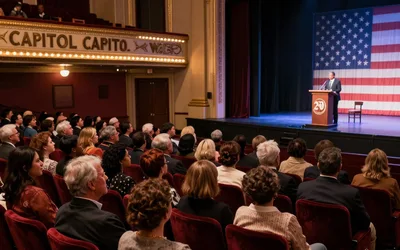
For more than four decades, the West Virginia Humanities Council has done something unusual for a state its size: once a year it puts a nationally known scholar or writer on a stage in Charleston and opens the doors to anyone who wants to come. No ticket, no membership, no gate. The tradition is called the Betsy K. McCreight Lecture in the Humanities, and its 44th edition arrives at the Capitol Theater in Charleston at 7:30 p.m., with historian and three-time Pulitzer Prize winner Rick Atkinson as the speaker.
The occasion this year is the 250th anniversary of the Declaration of Independence. The Council describes the lecture as a way of marking what it calls the nation's "birthday," and it picked a speaker whose recent work sits squarely on that ground. Atkinson is the author of The British Are Coming, the first volume of his Revolution Trilogy, which won the George Washington Prize and the New-York Historical Society's Zalaznick Book Prize. The second volume, The Fate of the Day: The War for America, Fort Ticonderoga to Charleston, 1777-1780, carries the narrative through the war's middle years. He also served as a historical advisor on Ken Burns's PBS documentary series The American Revolution, which was made for the same anniversary.
Atkinson's career before the Revolution trilogy is its own story. Born Lawrence Rush Atkinson IV in Munich in 1952, the son of an Army officer, he turned down an appointment to West Point and instead took a full scholarship to East Carolina University. He spent years at The Washington Post as a reporter, editor and foreign correspondent before turning to military history. His Liberation Trilogy, on the American role in the liberation of Europe in World War II, concluded with The Guns at Last Light in 2013. His Pulitzers span both halves of his working life: two for journalism and one for history, for An Army at Dawn, the first volume of the Liberation Trilogy. In 2010 he received the Pritzker Military Library Literature Award for lifetime achievement in military writing. His books include narrative accounts of five different American wars.
The lecture series itself has a longer memory than most of its audiences realize. According to the West Virginia Humanities Council, the annual McCreight Lecture has been running since 1981, when the Council's board established it. The Council itself was created on June 25, 1974, at the encouragement of the National Endowment for the Humanities, and was first incorporated as the Committee for Humanities and Public Policy, focused on grants that applied the humanities to public-policy discussions among adults. Over the decades it broadened into a nonprofit with an annual budget around $1.2 million, most of it raised in West Virginia, and the McCreight Lecture became its signature public event, presented each October and devoted to bringing "nationally respected scholars and public intellectuals" before a general audience.
The roll call of past McCreight speakers shows how consistently the Council has aimed high. In 2012 the lecturer was Edmund Morris, the Pulitzer-winning biographer of Theodore Roosevelt and Ronald Reagan. In 2024, as part of the Council's own fiftieth-anniversary year, the speaker was Percival Everett, author of more than thirty books of fiction and poetry, whose novel Erasure was adapted into the Oscar-winning film American Fiction. In 2025 the lecture went to Viet Thanh Nguyen, who won the 2016 Pulitzer Prize for Fiction for his debut novel The Sympathizer, later an HBO miniseries. Each year the format is the same: one evening, one speaker, a historic downtown theater, and no charge at the door.
That continuity has not been effortless lately. In 2025 the newly created federal Department of Government Efficiency abruptly terminated support for the West Virginia Humanities Council, eliminating what executive director Eric Waggoner described as about $500,000 in allocated federal funding, roughly half the council's annual operating budget. A mid-year grant from the Andrew W. Mellon Foundation, routed through the Federation of State Humanities Councils, helped keep the doors open, and the Council went back to Capitol Hill to make its case to West Virginia's congressional delegation. Congress subsequently passed appropriations legislation restoring and directing the funds. The McCreight Lecture, in other words, is being staged in a year when the money behind it was very much in question.
The venue fits the series' ambitions. The Capitol Theater at 123 Summers Street sits in the heart of downtown Charleston, a restored movie palace from the city's theatrical past, and it has become the lecture's regular home. Atkinson's talk is scheduled for 7:30 p.m. and is free and open to the public.
There is a certain symmetry in the pairing. Atkinson has spent the last several years writing about a war fought over whether a new nation would exist at all, and he will now describe that war in a state that was not yet a state when it was fought, in a theater named for the capital city it eventually got. The Council's framing is simpler: for over four decades, the lecture has connected West Virginia audiences to some of the nation's premier public intellectuals. On an October evening, for the price of a parking spot, that connection is available again.