


On a Saturday morning in late September, when the air smells of turning leaves, a different kind of pilgrimage begins at Green Bay's Bay Beach Wildlife Sanctuary. It's not a race. There are no finish-line clocks or timing chips. Just families, retirees, strollers, and the occasional toddler, walking 2.5 miles of wooded trails in search of a vulture, an owl, a fox, or a fawn around every bend.
The occasion is the Walk for Wildlife, the 21st annual fundraiser for the sanctuary's R-PAWS rehabilitation program, set for September 19, 2026, from 8 a.m. to 12:30 p.m. Registration runs between $5 and $20, kids under five walk for free, and everyone who completes the loop goes home with a collector's pin and a long-sleeved t-shirt. But the real currency of the morning is quieter: it's measured in syringes, heating pads, antibiotics, and second chances.
"Why do we walk for wildlife?" the event organizers ask on their registration materials. The answer appears in the numbers they publish each year: 7,000 orphaned, injured, ill, and displaced wild animals were brought to the sanctuary in 2025 alone. Each one arrived with a story — a nest blown out of a tree, a car that didn't stop, a lawn mower that didn't see the fawn, a window that looked like sky. Each one also arrived with a need: specialized formulas for a raccoon kit, antibiotics for an infected eye, an x-ray for a broken wing, a heating pad for a cold, trembling cottontail.
The walk itself is the gateway; the pledges and raffles — bundles of 25 tickets for $20 — do the heavy lifting. Raffle tickets go for a dollar each, six for five bucks, or the "famous wingspan" bundle of 25 tickets for $20.
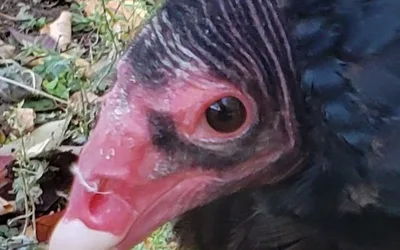
This year's mascot is Victor the Vulture, a turkey vulture who has become something of a celebrity at the sanctuary. Found as an infant in a barn in 2009 with his wing already fully missing — the cause unknown — Victor has spent nearly two decades as an animal ambassador. He purrs, according to his caretakers, producing low guttural sounds that seem wildly at odds with his grim reputation. (Turkey vultures are not buzzards, the sanctuary's materials insist, and their bald heads are an adaptation, not a fashion statement: the bare skin keeps carrion from getting stuck in feathers as they feed.) Victor will greet walkers at Station 1, presiding over the morning like the feathered monarch he believes himself to be.
The sanctuary itself has a long history in Green Bay. It has grown into a 700-acre urban refuge — the largest park in the Green Bay municipal park system — and home to a major wildlife rehabilitation program in Wisconsin. Its history is stitched together from small, stubborn acts of generosity: college students selling buttons to fund the dredging of the main Feeding Lagoon in 1971; the Marine Corps Reserves doubling the size of the observation building in 1978; private donations totaling $1.7 million opening the Nature Education Center in 1985. The Friends of the Wildlife Sanctuary — the non-profit support group that organizes the Walk for Wildlife and collects registration checks made out to FOWLS — was formed in 1978, giving the community a permanent channel for its affection.
The sanctuary's rehabilitation program has banded geese since 1965, a project that has produced over 28 years of data and is rated the longest-running banding program in Wisconsin. It has weathered floods and adapted, hiring its first college-trained professional manager in 1970. Today, its team and volunteers work year-round to release as many animals as possible back into the wild. "With volunteers, donations, and this fundraiser, the Sanctuary's R-PAWS program gives each animal the chance they deserve to become wild again," the event description reads. That phrase — "become wild again" — is the heart of the whole endeavor.
The event itself has evolved into something of a festival. Local musicians from the Good News Band play live. Fantastical Friends — two nature-loving princesses — wander the grounds. Food trucks line up near the Nature Center. At each animal station, volunteers introduce sanctuary ambassadors — the non-releasable animals who serve as living educators — and answer questions. Walkers who ask a question at a station receive a stamp on the Passport they got at registration, and a fully stamped passport enters them into a drawing for a stuffed animal.
Packet pickup happens the evening before, on Friday, September 18, from 4 to 6 p.m. at the Nature Center. Day-of registration runs from 8 to 11 a.m. at the amphitheater, and the animal stations stay open until 12:30 p.m. so even slow walkers with small legs can meet every ambassador. Water filling stations are scattered along the route, so participants are asked to bring their own bottles. Dogs are welcome everywhere else, but not here — the whole point is that the animals, not the humans, are the guests of honor.
For 21 years, this walk has threaded through the same pine-shaded paths that crews shaped nearly a century ago. The names change — this year's mascot is Victor, last year's might have been an owl or a fox — but the arithmetic stays the same. Seven thousand animals came in last year. Every dollar from the walk goes to bring that number down. Every pin collected, every t-shirt worn, every passport stamped is a small act of solidarity with a barn-raised vulture who lost a wing and found a purpose. On September 19, the trail will be full of people who came for the walk and stayed for the wild.