


If you want to understand why Madison's near east side gets a little weird every September, you need to understand what happened on Williamson Street in the late 1970s. A fast-food chain wanted to move in. The neighbors—an eclectic mix of artists, activists, and working-class families—wanted something else entirely. So they took back their street, filled it with musicians and makers, and accidentally created a tradition that has outlasted nearly half a century of change.
That tradition returns this weekend. From noon to 10 p.m. on Saturday, September 19, and 11 a.m. to 6:30 p.m. on Sunday, September 20, the 49th Willy Street Fair will take over the 800, 900, and 1000 blocks of Williamson Street—known to everyone in Madison simply as Willy Street—for two days of free music, food, art, and unabashed neighborhood pride. Produced by Common Wealth Development and the Wil-Mar Neighborhood Center, all proceeds benefit the two nonprofits that anchor this community, serving thousands of residents each year through housing support, food programs, workforce development, and youth services.
The fair's origin story reads less like a civic planning document and more like a folk tale. Justice Castañeda, executive director of Common Wealth Development, puts it plainly: the protests were about a Taco John's. "There was going to be a Taco John's, and there were a lot of protests around Taco John's coming in," Castañeda told WKOW. "So they protested, and they did a take-back-the-streets event. And it was artists and musicians." That first gathering in 1977 has since grown into Madison's longest-running neighborhood festival, though its roots remain visible in every corner of the weekend. This is not a polished corporate street fair; it is a community reclaiming its own block, every year, on purpose.
The neighborhood those first organizers fought for was not the Willy Street of today. Through the 1970s and early 1980s, Williamson Street was in decline, struggling with disinvestment and neglect. The fair was never just a party—it was a declaration that this place mattered, that the people who lived here had a say in what their street became. That ethos is baked into the organizations that now run the event. Common Wealth Development, which grew out of those same neighborhood struggles, works on affordable housing, small business incubation, and racial justice. The Wil-Mar Neighborhood Center, founded in 1968, has spent more than five decades providing food, wellness programs, and community gathering space to anyone who needs it. When you buy a beer or a handmade bracelet at the fair, you're not just having fun—you're funding food pantries and housing programs.
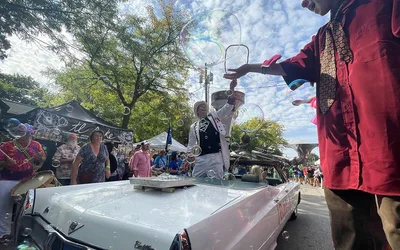
Nowhere is the fair's soul more visible than in its Sunday morning parade. At 11 a.m., the procession steps off from Willy Street, winds around the streets of the Williamson-Marquette neighborhood, and returns to where it began. At its head, for as long as almost anyone can remember, rolls the Bubble Mobile.
Jim Wildman has attended every single Willy Street Fair since the beginning. Since 1978, the fair's second year, he has driven a Bubble Mobile in the parade—a vintage Cadillac convertible fitted with an absurd tangle of brass automotive horns that spray soapy bubbles over delighted crowd. The current car, a 1967 Cadillac, is the fourth iteration of the Bubble Mobile. Wildman has become as essential to the fair as the street itself, a living link to the event's scrappy origins. Following the Bubble Mobile come local organizations tossing candy, Madison Circus Space performers rolling along on unicycles, the Forward! Marching Band pounding out horns and drums, stilt walkers, costumed revelers, and hula hoopers. It is, by any reasonable measure, a glorious chaos.
Between the parade and the closing acts, the weekend unfolds across four stages, each with its own personality. The Main Stage, in the 900 block, carries the biggest names: Saturday features the Afro-funk of Ben Mulwana & the Village and the rock of Honor Among Thieves, while Sunday closes with a raffle drawing and The Jimmys. The Folk Stage at Ingersoll offers a more intimate counterpoint, with Saturday highlights including Bruised Orange, a John Prine tribute band, and the Roddys Trio. The Willy Street Beats Stage in the 800 block brings the dance floor energy—on Saturday it spins hip-hop and electronic sounds, including Chicago house legend Boo Williams, and on Sunday it transforms into the WORT stage, hosted by Madison's beloved community radio station. And the Kids' Stage near Brearly keeps the youngest festivalgoers entertained with magicians, youth orchestras, karaoke, and the always-entertaining talent showcase.
There's a practical side to all this fun, too. Parking around the fair is scarce, with no designated lots, though plenty of bike parking is available. Pets are strongly discouraged, and the street closes to vehicles from Saturday morning until Sunday night. The fair is free and open to everyone, but if you want to help keep it alive for another half century, there are raffle tickets, vendor booths, and donation opportunities throughout the weekend.
More than 150 vendors line the three blocks, selling everything from Lao Laan-Xang's Laotian cuisine to Monsoon Siam's Thai food to El Sabor's Mexican dishes, alongside jewelry, pottery, paintings, and crafts from local artists. For Packers fans, there's a tent with the game on Sunday, complete with improv comedy from Monkey Business Institute during commercial breaks.
Castañeda knows better than most why this fair matters beyond the funnel cakes and face paint. He has drawn direct lines between the fair's protest origins and the neighborhood's more recent grief—including the shooting death of Corey Ruiz on Williamson Street and the community demonstrations that followed. "The tragedy that was the killing of Corey Ruiz is something that will resonate, and it will transcend events and things that are going to happen in the neighborhood forever," Castañeda said. The fair, he suggests, is part of how this community keeps showing up for each other, year after year, through good times and hard ones.
Gary Kallas, executive director of the Wil-Mar Neighborhood Center, says the fair also helps local businesses recover from a difficult summer. "I think it's going to bring renewed momentum to the notion that Willy Street is, if you will, open for business," Kallas said. "The momentum of the fair will help in that regard."
Nearly fifty years in, the Willy Street Fair has become something its founders might not have dared to imagine: a beloved institution that still refuses to be respectable. It is a protest that turned into a party, a block party that turned into a neighborhood's lifeblood, and a parade that has been led by the same man and the same bubble-blowing Cadillac for almost as long as the fair has existed. In an era when so much of American life is polished, branded, and focus-grouped, the Willy Street Fair remains gloriously, stubbornly itself—weird, wonderful, and utterly free.
So go. Bring your bike, leave the dog at home, and stand on the corner of Livingston and Willy as the Bubble Mobile rolls past, spraying soapy rainbows over a crowd that has been waiting all year for exactly this moment. The street belongs to the neighbors. It always has, and—if the last 49 years are any indication—it always will.