


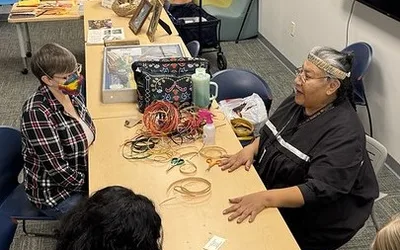
On the evening of October 14, 2026, the Goodman South Madison Library will smell faintly of damp wood and paper. That is what happens when a room full of strangers, schoolchildren and grandparents alike, sit down to weave. The occasion is "Teejop & Beyond: Paper Basketmaking," a free workshop led by the Ho-Chunk basket maker Kimberly Crowley and her apprentice. Attendees will help weave two communal Black Ash baskets that will later go on display at the library, and each participant will also make a personal paper basket to take home. The workshop runs from 5:30 to 7:30 p.m. at 2222 South Park Street, and it is open to everyone from school-aged kids through adults, with youth especially encouraged. Registration is required, and it opens September 30 at 9 a.m., either online or by calling the branch at 608-266-6395.
The event is one installment of Teejop & Beyond: Celebrating Native Nations, an annual fall series that Madison Public Library runs in partnership with Ho-Chunk Gaming Madison. Teejop (pronounced day-JOPE) is the Ho-Chunk name for the place now called Madison, meaning "Four Lakes," and the series takes its name from that word plus the communities beyond it. The program began in the fall of 2021, and it has grown every year since. Native community members told library staff they wanted more than the occasional one-off program. They wanted sustained, deeper engagement. The 2026 edition opens on Indigenous Peoples' Day, October 12, and runs through November, with presenters representing the Ho-Chunk, Oglala Sioux, and Oneida nations leading programs on art, making, storytelling, and handicrafts.
Crowley is a natural fit for that mission. She is a member of the Thunder clan of the Ho-Chunk Nation, the third daughter of Sidney Hall Sr. and Christine Hall, and she grew up in Wittenberg, Wisconsin, with ten siblings before settling in Baraboo, where she now lives with her family. She has been making baskets for more than four decades, and for roughly the last several years she has devoted herself to teaching the craft, which she has described as an art that is slowly dying out. Her two granddaughters, Brooklyn and Ariel, are her apprentices in training; they assist her in classes, and their baskets, along with hers, are held in museums around Wisconsin.
The family name matters here. Crowley belongs to the Hall family, long known for its master Ho-Chunk black ash and miniature basket weavers. Basket weaving is among the longest-practiced Ho-Chunk artistic forms, and both women and men of the nation continue to make baskets professionally today.
The craft itself is older than the state around it. Ho-Chunk people have been weaving baskets from the wood of black ash trees, which are native to the Great Lakes region, since at least the 1820s. A story passed down through generations explains how it began: a Ho-Chunk woman had a dream in which a voice guided her to a black ash tree and told her to cut strips of the wood and weave them together. At the end of the dream, the voice promised she would never want for money, because she could trade or sell what she made. That promise held. By the mid-twentieth century, Ho-Chunk makers commonly sold their baskets at roadside stands in the Wisconsin Dells and other tourist destinations, and for many years the trade was an economic engine for the tribe. As the Ho-Chunk artist and collector Tom Jones has put it, it is almost as if every family in Wisconsin has a Ho-Chunk basket.
What makes black ash suited to the work is a rare quality: the tree is ring-porous, meaning its annual growth rings separate cleanly when a log is pounded along its length, yielding the long, thin splints that weavers use. Preparing those splints is laborious and communal, involving selecting and felling a tree, stripping its bark, and pounding the trunk with the back of an axe head until the layers split apart at the rings. It is a process that has traditionally drawn in several people at once, and it is one reason basketmaking has always been as much a social practice as an artistic one.
That practice is now under pressure. The emerald ash borer, an invasive beetle from East Asia first detected near Detroit in 2002, kills the great majority of the ash trees it reaches. It was confirmed in Wisconsin in 2008. For basketmakers across the Great Lakes and the Northeast, the loss of black ash is not only an ecological problem but a cultural one, threatening the raw material on which generations of knowledge depend. Crowley has continued to weave despite that threat, and her teaching carries a double purpose: passing on a technique and keeping the material's story alive.
The October workshop reflects that in its structure. Rather than sending each person home with only a private souvenir, it asks the group to build something together, two communal baskets that will stay at the library after the participants leave. The take-home paper basket is the parting gift; the Black Ash baskets are the legacy. It is a small gesture, but it mirrors how the craft has always worked, with many hands around a single log, and it puts a piece of Ho-Chunk artistry permanently in a public building on South Park Street.
The workshop is free, part of a series made possible by the Friends of Madison Public Library. The library offers interpretation, translation, and disability-related accommodations at no cost; requests can be made by calling 608-266-6395. More information on the full Teejop & Beyond schedule is available at madpl.org/teejopandbeyond.