


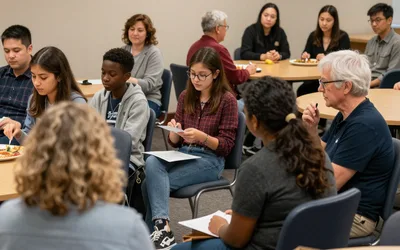
On the evening of October 14, 2026, a meeting room at a Madison Public Library will fill with the smell of pizza and, shortly after, the disorienting experience of trying to read when the letters won't hold still. The library and the Children's Dyslexia Center of the Madison Area are marking October as Dyslexia Awareness Month with their annual celebration: a light pizza dinner at 5:30pm, a free abbreviated dyslexia simulation at 6pm, and a talkback afterward featuring local dyslexic students.
The event is designed for parents, caregivers, educators, elementary school and older youth, and community members, and families are especially welcome. It is not recommended for children age 7 and under. Registration is appreciated but not required; families can call 608-266-6385 or sign up through the library's event page. Those who need interpretation, translation, or a disability-related accommodation can arrange it at no cost through the same number, and librarian Abby Ryan asks that accessibility or dietary requirements be flagged a week ahead.
The simulation is the centerpiece, and it is a peculiar kind of invitation. A dyslexia simulation is not a lecture about a learning disability; it is an attempt to make a reader feel one, briefly. The tool is deliberately imperfect, and the organizations that use such simulations are careful to say so: no simulation captures every dyslexic experience, because every dyslexic brain works differently. What it can do is give a parent or a teacher a few minutes of the frustration their child or student lives inside daily, and that glimpse is often the point at which understanding replaces impatience.
The talkback that follows will be moderated by Kelly Kuenzie, director of the Children's Dyslexia Center-Madison, and Abby Ryan, a youth services librarian, and will feature local dyslexic students speaking for themselves. That pairing is the heart of the evening: the simulation supplies the feeling, and the students supply the reality that no scrambled paragraph can fully represent.
The Children's Dyslexia Center-Madison is a Scottish Rite charity housed inside the Wisconsin Masonic Center at 301 Wisconsin Avenue. It provides one-on-one, multisensory reading and written-language tutoring to children, free of charge, and it keeps a waitlist because demand outruns the supply of trained tutors. The national Children's Dyslexia Centers were founded in 1994 through a partnership between the Scottish Rite Freemasons of the Northern Masonic Jurisdiction and the Language Disorders Unit of Massachusetts General Hospital.
Kuenzie's own history with the place runs long. A Milwaukee native and a graduate of Winona State University, she began training and tutoring at the Madison center in 2002 and now serves as its director. She is not the only person there who came to the work through personal experience. Joan Ziegler, who has tutored at the center for two decades and now trains and supervises other tutors, discovered her own dyslexia in a college class on the subject. "I said, 'Oh my God, that's me,'" she told the Cap Times in 2023. "All these years, I never knew what it was, so that was kind of an eye-opener." The center's approach is intensive and structured, and it asks a great deal of its volunteers: becoming a tutor requires 55 hours of classroom instruction, six hours observing experienced tutors, a 100-hour practicum, and a two-year commitment to at least two students.
The stakes are larger than any single family. The International Dyslexia Association estimates that as many as 15 to 20 percent of people have some symptoms of dyslexia, which affects reading, writing, spelling, and pronunciation. That is roughly one in five people in any classroom, any workplace, any library meeting room. The gap between that number and the number of people who understand what it actually feels like is the space this event is trying to close.
This is not the first year the library and the center have partnered for October. In 2025, the celebration took the form of a screening of the documentary "Left Behind" (2025), about a group of mothers in New York City who organized to create the city's first public school for dyslexic students, followed by a talkback with Kuenzie, Dr. Barb Novak of the Wisconsin Department of Public Instruction's Office of Literacy, and Krissy Wick, the library's director of public services. The year before that, the partnership explored the brain science of reading and ADHD with help from UW-Madison neuroscience students. The format changes; the mission doesn't. The center also runs an annual Walk for Dyslexia each spring at Brittingham Park, a 5K fundraiser whose T-shirt is designed each year by a current student, and it maintains a booklist of library resources centering dyslexic characters.
What makes the October 14 gathering unusual is its intimacy. There is no ticketing, no fee, no barrier beyond showing up and, if you like, calling ahead. A parent who has watched a child come home defeated by a worksheet can sit in a room and, for a few minutes, feel the page fight back. Then they can turn to a student who has lived it for years and ask what actually helps. Pizza, a scrambled paragraph, and a conversation with the kids who know the difference: it is a modest recipe for a kind of understanding that is hard to teach any other way.