


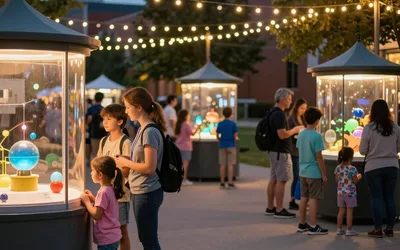
On the evening of October 15, State Street will turn into a place where you can buy a hand-thrown mug, watch a physics demonstration, and extract DNA from a strawberry, all within a few blocks and without spending a dime on admission.
Science on the Square returns for its ninth year in 2026, once again fused with the Madison Night Market for a single evening of hands-on science and local commerce running from 5 to 9 p.m. throughout downtown. The event is organized by the Wisconsin Science Festival and Madison's Central Business Improvement District, in partnership with Brothers Molloy Events, and it serves as the opening night of the 16th Wisconsin Science Festival, a 10-day festival.
The fusion is the interesting part. Science on the Square began as a standalone downtown science celebration, and the Night Market had already become a downtown staple. Rather than split the crowd, the two merged. The result is a rare thing in the festival world: an event where a vendor selling artisanal spices and a graduate student explaining the origins of life are, functionally, colleagues.
The 2026 festival's theme is "Us" — the science of humans and the humans who do science. That theme lands especially well at the Madison Children's Museum, at 100 North Hamilton Street, which will host a free evening of museum fun from 4 to 8 p.m. as part of the broader event. The museum's lineup reads like a tour of the university's less intimidating corners: strawberry DNA extraction with Wisconsin Agriculture in the Classroom, a "Keep your lungs squishy!" station from the School of Medicine and Public Health, a human brain demonstration from the UW–Madison Neuroscience Training Program, robotics demos from BadgerBots Team 1306, and a "Sleep Superheroes" station from SleepHealth Ambassadors. There is also "Bug Out!" with the Wisconsin Department of Agriculture, Trade, and Consumer Protection, and a "Learning through your body" station from the WCER MAGIC Lab.
Outdoors, the science spreads along State Street. At the top of the street near the Capitol, physics demonstrations will run alongside a giant "Science Brite" where visitors can create a glowing design. Farther down, at Lisa Link Peace Park on the 400 block, live music anchors a stretch of hands-on science stations. The Madison Central Library gets in on it too, hosting UW–Madison Astronomy's "Stargazing Over the Square" from 5 to 8:30 p.m., with astronomy activities on the third floor beginning before dusk. For adults who want their science with a pint, there is the Stumble Into Science Pub Crawl, a guided walk through some of Madison's most iconic bars, each staffed with researchers fielding questions on topics ranging from microbiology to astronomy to cannabis research.
The scale of what the Wisconsin Science Festival has become is worth pausing on. Founded on the premise that art and science go hand in hand, it has grown into a 10-day, statewide celebration of science, art, and technology. The festival's own framing is that science is human work and every curious mind belongs, which is a polite way of saying that the people who do science are not a separate species, and the people who attend are not an audience so much as participants.
That spirit is visible in the details. The Children's Museum stations are not lectures. They are things you do with your hands: extract, build, touch, breathe. The "Mind games: explore how your brain works" station from the Social and Moral Learning Lab and the "Story Stones" activity from the Language Acquisition and Bilingualism Lab are designed for kids, but the adults who wander in tend to linger. The BadgerBots robotics demonstrations draw a crowd of all ages. And the strawberry DNA extraction — a perennial favorite — has a way of making the abstract suddenly physical: you can hold a clump of the stuff that makes a strawberry a strawberry.
The Night Market side of the equation matters too. More than 100 local artists, makers, and food vendors typically participate in the October market, alongside State Street businesses offering specials and extended hours. The Family Activity Zone, where State Street meets Capitol Square, keeps kids occupied with a rotating slate of activities from community partners. It is, in other words, a genuine market — not a science fair with a few tents bolted on.
What makes the evening unusual is that it asks nothing of you. There is no ticket, no capacity limit, no registration. You can arrive at 5 p.m. for the physics demos, drift into the Children's Museum for the brain demonstration, buy dinner from a food cart, catch the live music at Lisa Link Peace Park, and end the night stargazing at the library. Or you can do none of that and simply walk State Street, which on this particular Thursday will be doing what it does best: mixing the university, the Capitol, the shops, and the crowd into a single continuous block of downtown life.
The Wisconsin Science Festival runs October 15–25, 2026, with events across the state. Science on the Square — the Madison Night Market fusion — runs 5 to 9 p.m. on Thursday, October 15, in downtown Madison, with the Madison Children's Museum hosting free activities from 4 to 8 p.m. Admission is free. Details on participating businesses and hands-on station locations will be posted closer to the event at wiscifest.org/SotS.