


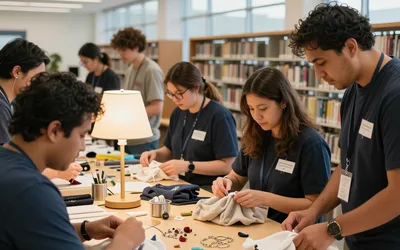
On a Saturday in June, a small crowd gathered at the Teton County Library with an odd assortment of burdens: a lamp that wouldn't switch on, a sweater with a hole in the elbow, a bracelet whose clasp had given up, a knife gone dull from years of kitchen duty. By the time the afternoon ended, volunteers had worked through these broken things, sending them home repaired instead of to the landfill.
That was the first Teton Repair Café, a pilot program of the Teton Resilience Network. On Saturday, October 17, the café returns to the library at 125 Virginian Lane, this time timed to International Repair Day, the annual global celebration of fixing things rather than replacing them.
The idea is simple and deliberately unglamorous. Bring one broken item. Sit down with a volunteer who knows how to fix it. Work alongside them. Pay nothing. There are no tickets and no reservations — it's a drop-in event running through the day. The point isn't just to salvage the item; it's to watch how it's done, so that the next time something breaks, you might try it yourself.
The stations at the June event covered jewelry, clothing and textiles, small appliances, lamps, bicycles, furniture, and computers, along with a knife-sharpening booth. There was also a kids' tinker table, where children were handed broken gadgets and invited to take them apart — the first step, as the organizers put it, in learning to repair anything at all. The October event is expected to offer a similar spread, and the organizers ask attendees to check the website beforehand to see exactly what will be on the bench that day.
The Teton Repair Café is modeled on an international movement that began in the Netherlands. In 2009, Martine Postma, a Dutch journalist who had spent years pushing for sustainability at the local level, organized the first Repair Café at the Fijnhout Theater in Amsterdam-West. The date was October 18, 2009 — a detail that gives the October event in Jackson a certain symmetry. The following March, Postma established the Repair Café Foundation to help other communities launch their own versions, and the idea spread: first across the Netherlands, then to Belgium, Germany, France, the United Kingdom, the United States, and dozens of other countries. Today there are thousands of Repair Cafés worldwide, all operating on the same premise — that a throwaway culture is a choice, not an inevitability, and that the skills to resist it are worth preserving and passing on.
The movement's philosophy is sometimes summarized as "do-it-yourself" meeting "do-it-together." Repair Cafés are typically held in community spaces — churches, libraries, college campuses — where tools are available and where a person with a broken toaster can sit across from a person who knows how to fix one. The events are part of a broader grassroots push against overconsumption and planned obsolescence, and they double, almost incidentally, as social occasions.
That social dimension is explicit in Jackson. The Teton Repair Café is presented by four partners: the Teton County Library, the Teton Resilience Network, Teton Habitat ReStore, and Teton County Integrated Solid Waste and Recycling. The last of those gives the event a concrete local stake. Teton County adopted a Zero Waste Resolution in 2014 and now aims to divert 60 percent of its landfill waste by 2030. In a valley that draws more than 3.5 million visitors a year, every lamp that gets rewired and every jacket that gets re-stitched is a small subtraction from the waste stream — and a small addition to the stock of repair knowledge held by the people who live there.
The Teton Resilience Network itself is a relatively new organization, formed from the merger of two older local groups: the Riverwind Foundation, founded and directed by Tim O'Donoghue from 1999 to 2023, and the Jackson Hole Climate Action Collective, which operated from 2020 to 2025. The merged organization describes its mission as advancing "sustainable, equitable and climate-resilient communities in the Tetons and beyond." The Repair Café sits comfortably within that mandate, though it may be the network's most tactile program — less about policy and more about a screwdriver, a needle, and an afternoon.
For the October edition, the organizers are hoping to scale up. The announcement for the fall event notes that a bigger turnout is expected — which means more hands are needed. They're recruiting people with skills in light furniture repair, sewing, toys and small electronics, jewelry and eyewear repair, lamps and other electrical appliances, and outdoor gear repair. But they're also explicit that fixing isn't the only way to help: they need greeters, people to help with transport, photographers, and volunteers willing to simply celebrate a repair when it happens. Prospective volunteers can fill out a form on the organization's website, and questions go to [email protected].
What the event offers, in the end, is a slightly old-fashioned proposition dressed up as a new one. Most of us own something we can't quite bring ourselves to throw away — a chair with a wobble, a chain with a snap in it, a favorite sweater gone thin at the elbows. The Repair Café's wager is that the distance between "broken" and "useful" is often much shorter than we assume, and that closing that distance is more satisfying when someone shows you how. Bring one item. Sit down. Leave with it working, and with a little more faith that the next broken thing is fixable too.
The Teton Repair Café runs Saturday, October 17, at the Teton County Library, 125 Virginian Lane in Jackson. It's free and open to all.