


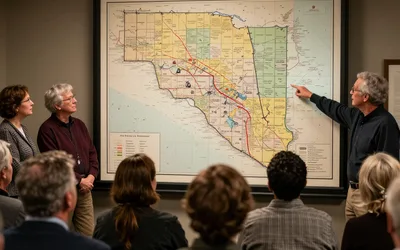
Long before Sheridan, Wyoming, became the ranch-and-rodeo town of the popular imagination, its economy ran on coal. Beginning in the early 1890s, when the Burlington Railroad reached Sheridan, a string of mines opened along the Tongue River north of town, and beside them sprang up company towns — coal camps — where the miners lived with their families. On Wednesday, Oct. 14, 2026, from 10 to 11:30 a.m., Sheridan Community Land Trust Director of History Kevin Knapp will bring that vanished world back into the room with a talk titled "The Coal Camps of Sheridan County," held at The Hub on Smith at 211 Smith Street in Sheridan. It is free and open to all.
Knapp's presentation draws on his own research and writing on the subject. The story he tells is one of a region transformed almost overnight. According to WyoHistory.org, Sheridan County's population skyrocketed between 1890 and 1920 as a direct result of the state-of-the-art mines opened along the Tongue River. The boom pulled in investors from across the United States and drew a strikingly diverse workforce: most of the miners were immigrants from central and eastern Europe, and their arrival reshaped the cultural life of a county that today markets itself on cowboy heritage. Few buildings or artifacts survive at the former camp sites, but the cultural imprint of those mining families remains woven into Sheridan.
The camps had names that once carried the weight of whole communities — Dietz, Acme, Carneyville (later renamed Kleenburn), Monarch and Kooi among the largest. In 1909, Dietz alone produced roughly 255,000 tons of coal and employed 450 men. Knapp has documented Monarch in detail in past Explore History programs, describing company-built houses, the water tower that still stands above the site — where miners pumped water up from the Tongue River so gravity could carry it down to the tipple, both to suppress coal dust and to fight the frequent fires that coal-heated homes produced — and the Monarch Band, started by local young people, which played throughout the region. SCLT volunteers have also worked to clean up and document the two cemeteries near Monarch, the Lutheran and St. Thomas burial grounds, donating those records to the Wyoming Room at the Sheridan Fulmer Public Library.
Mining was, as WyoHistory.org puts it, the most dangerous occupation on the Western frontier — more hazardous than cattle ranching, railroad work or soldiering. Before 1886, Wyoming mines were entirely unregulated, and from the start of mining near Carbon in 1868 until 1925, thirteen separate disasters killed five or more miners each, a toll that does not count the individual deaths and maimings from cave-ins, explosions and equipment failures. The coal camps of Sheridan County were company towns in the fullest sense: the company hired the miners, built the houses, and, as Knapp has noted of Monarch, made a great deal of money doing it. He has also recounted the 1907 case in which Monarch's owners were indicted and found guilty of conspiracy to defraud the government and faced two years in prison, only to have the conviction set aside because the statute of limitations had run out.
The mines did more than extract fuel. They poured money into modernizing Sheridan itself — power plants, paved streets and irrigation projects — and in 1910 the Sheridan Railway Company was established to meet the needs of local industry and its workers. Its fleet of ten streetcars carried miners into town and back out to the shaft mines, a reminder that the small village of Sheridan and the tens of thousands of people living and working in the company towns to its north were, for a time, a single economic organism. Wyoming's last surviving streetcar, "Ol' #115," was moved in November 2025 to SCLT's Big Goose Natural Area, where it will stand as a permanent outdoor exhibit on that history. Knapp, who has served as the land trust's history program manager, called the move a vindication after decades in which the trolley sat exposed and was shuffled around town. "Our mission is conservation, recreation, and history," he told Cowboy State Daily. "The streetcar fits into our idea of demonstrating, educating, and interpreting history for people in an open, public space."
That same impulse — interpretation in public, for anyone who shows up — is what drives Explore History. The program launched as a monthly series of talks, tours and programs created by SCLT and hosted at The Hub on Smith, with each month taking up a different corner of Sheridan County history: dude ranches, the lives of the former coal-mining communities, the women who shaped southeastern Sheridan County. Guest speakers anchor the presentations, but the format deliberately leaves room for an open dialogue in which attendees ask questions and, just as importantly, share their own memories of calling Sheridan County home. The series later expanded to the Tongue River Valley Community Center in Dayton, where programs are held on the third Tuesday of the month, after TRVCC assistant director Lacie Schwend noticed that the center's best-attended outings all had a history component. A past TRVCC outing along SCLT's Black Diamond Byway tour drew rave reviews, with many attendees who had grown up in and around the coal-mining communities adding personal stories to the tour.
For Carrie Edinger, SCLT's historical program manager, those contributions are the point. "It's always exciting to hear the stories and memories shared by the people who lived our local history," she said. "Those moments are part of the reason why we created Explore History and when they are shared, stories can be preserved so they aren't forgotten." Schwend put it more simply: "There is no person alive who would not benefit from learning the history of where they live."
The Oct. 14 program is a collaboration of the Sheridan Community Land Trust, The Hub on Smith and the Tongue River Valley Community Center. The Hub, at 211 Smith Street, is a center serving older adults that also functions as a gathering place for the wider community, and it invites attendees to stay for lunch after the program concludes. No ticket or reservation is required — the talk is free and open to all. For anyone who has driven the Black Diamond Byway north of Sheridan and wondered what the scattered remnants along the roadside once were, or whose own family came to this corner of Wyoming to work the coal seams, the hour offers a chance to hear how dozens of bustling camps rose, produced, and then quietly disappeared, leaving behind a landscape that only looks empty.