


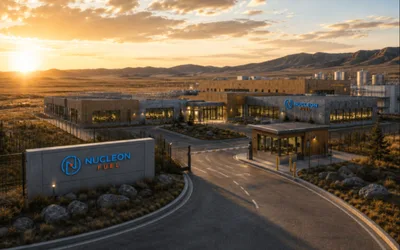
The meeting room is a college commons, the subject is uranium hexafluoride, and the invitation is unusually plain: come hear the company explain the technology and ask it whatever you want. On Wednesday, Oct. 28, at 6 p.m., Nucleon Fuel Ltd. will hold a public open house at Gillette College's Main Commons, where executives say they will walk Campbell County residents through a proposed uranium processing facility and field questions from the floor.
The project behind the meeting is a $575 million plant planned for Fort Union Industrial Park. Nucleon says the facility would take uranium concentrate — the powdery yellow material the industry calls yellowcake — and convert it into uranium hexafluoride, the chemical form that enrichment plants require before uranium can become reactor fuel. The company's own materials describe the design as the SMT-5000, a modular conversion unit sized to produce roughly 5,000 tonnes of uranium hexafluoride a year.
The economics are the part most people in Gillette have already heard something about. Nucleon is seeking a $20 million grant from the Wyoming Energy Dominance Fund, plus a possible $10 million loan, to help prepare for construction. The company says it would match the grant with $20 million of its own, for $40 million total to cover site confirmation, facility design, safety requirements, environmental permitting and buyer agreements between January 2027 and June 2029. Groundbreaking is targeted for 2030 or 2031, with commissioning in 2032. Nucleon also says it intends to put its U.S. nuclear fuel headquarters in Wyoming.
What makes the open house more than a routine sales pitch is the public money on the table. The Energy Dominance Fund is itself new. Created by Senate File 123 during the 2026 legislative session, it is administered by the Wyoming Energy Authority and is expected to collect up to $105 million over two years from severance tax revenue. Eligible categories include coal, oil and gas, pipeline infrastructure, enhanced oil recovery, transmission — and uranium, along with rare-earth and critical-mineral development. Applications opened with first-round concept papers due July 1, 2026. Executive Director Rob Creager framed the program as a way to "partner with industry, leverage private investment, and advance projects that strengthen our economy, support communities, and reinforce America's energy dominance."
Nucleon's application has already cleared one gate: a state review committee recommended it, which opened a 30-day public comment window. Written comments go to [email protected]. When that period closes, the application moves to the Wyoming Attorney General's Office and the Legislative Management Council before reaching Gov. Mark Gordon for final approval. The open house sits squarely inside that window — a chance for residents to hear the case in person while the state is still weighing it.
The company's pitch rests on a supply-chain argument. Nucleon Fuel, a subsidiary of Alberta-based Nucleon Energy, says Western conversion capacity is "dangerously low," concentrated among only two major commercial facilities in North America, with little room to take on new commitments. Conversion is the step between mining and enrichment, and it is easy to overlook until it becomes a bottleneck. Nucleon argues that geopolitical supply risk and the arrival of advanced reactors have made domestically controlled conversion infrastructure a strategic necessity rather than a niche service.
The regulatory track is moving in parallel. According to the WISE Uranium Project's running log of U.S. conversion and enrichment proposals, Nucleon Fuel notified the Nuclear Regulatory Commission in 2026 of its intent to begin pre-application engagement on a proposed U.S. natural uranium conversion facility — the first formal step toward licensing, and one that precedes any actual application.
Gillette, meanwhile, has heard this kind of pitch before. BWXT Advanced Technologies and its partner Kairos Power have proposed a $500 million nuclear fuel manufacturing hub at Pronghorn Industrial Park, backed by a $100 million state grant, that would turn enriched uranium into TRISO fuel for advanced reactors, with the companies promising high-tech local jobs and no nuclear waste production and targeting full operation by 2031. That project drew a packed auditorium on a July evening, a reminder that Campbell County's nuclear ambitions have already generated the kind of turnout that turns a weeknight open house into a standing-room event.
For all the numbers, the questions likely to dominate the evening are the ones the press release cannot answer. Conversion involves handling uranium compounds and fluorine chemistry; residents will want to know about emissions, water use, waste streams, emergency planning and truck traffic. They may also ask why a Canadian company needs Wyoming tax dollars, and what happens to the site if the private match never materializes. The source reporting on the project notes that the company did not respond to inquiries before publication — which makes a room where executives take unscripted questions the first real opportunity for the public to hear answers directly.
The open house is free and open to the general public, starting at 6 p.m. in the Main Commons at Gillette College. For a county that has spent a century supplying the country's coal, the evening offers an early look at a different kind of energy proposal — one that would put a link in the nuclear fuel chain, and a first-of-its-kind conversion plant, on reclaimed mine land just up the road.