


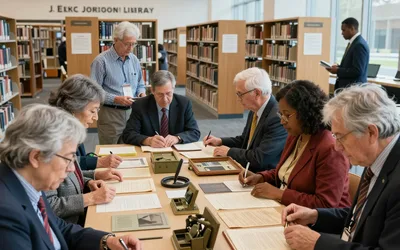
On a Saturday afternoon in early October, the seventh floor of the J. Erik Jonsson Central Library will fill with the kind of objects that usually live in attics, cedar chests, and the backs of closets: a great-grandfather's Civil War canteen, a bundle of yellowed letters, a campaign button from a presidential race nobody remembers, a photograph of people whose names have been lost. For three hours, specialists from Heritage Auctions will sit down with whoever walks in and try to tell them what they have.
The event is called Heirlooms & Heritage: A Community History Fair, and it runs from 1 to 4 p.m. on October 3, 2026, at the Central Library, 1515 Young Street. It is free, it is drop-in, and it is built around a simple premise: that the history of the United States is not only in museums but in the things ordinary families have kept. Bring a family heirloom, a document, a piece of military memorabilia, a digital file, or even just a story that has been handed down, and the appraisers will take a look. The focus is on political Americana, historical documents, and Civil War and militaria, though the format is deliberately loose, an antiques-roadshow-style encounter rather than a formal valuation.
What makes the setting unusual is that the library is not a neutral host. It is itself a repository of exactly the kind of object the fair is about. On the same floor, behind glass in a dimmed, sealed case, sits one of the surviving Dunlap broadsides of the Declaration of Independence, the only copy in Texas and, as the library's staff like to point out, the only one west of the Mississippi.
The Dunlap broadsides are the first printed copies of the Declaration, run off on the night of July 4, 1776, by John Dunlap, a 29-year-old Irish immigrant who ran a print shop in Philadelphia. There was no internet to spread the news, so the Continental Congress needed paper. Dunlap set the text by hand, one tiny wooden letter at a time, and worked through the night. Historians believe about 200 copies were printed, and riders carried them to towns and cities up and down the colonies, where officials gathered crowds and read the words aloud. For most Americans in the summer of 1776, that printed sheet was the first time they encountered the argument that the colonies were no longer part of the British Empire. The broadsides were not designed to be treasured. They were designed to spread news, which is why so few survived.
Dallas's copy has a story that sounds almost made up. For most of its life, nobody knew where it was. It resurfaced in 1968, when Leary's Book Store in Philadelphia, a business that had run for more than a century, finally closed. The store's consumer base had drifted to the suburbs, and the golden age of antiquarian bookselling was in its sunset. Amid the stock was a crate that had not been opened since 1911. Inside was the broadside. The discovery became known as the Leary copy, and it set off a quiet scramble among collectors and institutions.
Dallas won. The Friends of the Dallas Public Library, the same organization that is helping underwrite this October's history fair, were, in the words of Misty Maberry, the library's manager of Dallas History and Archives, instrumental in helping the library acquire the document and in getting the space built to hold it. The broadside now lives on the seventh floor in a sealed case that lights up its dimmed room, a deliberate piece of theater for a sheet of paper that was never meant to last.
That the fair and the broadside share a floor is the point. The event is part of a year-long Dallas Public Library initiative called 250 Years of Us: Reading America's Past, Writing Our Future, mounted for the semiquincentennial of American independence. The programming is supported by the Friends of the Dallas Public Library and by the General Levi Casey Chapter of the Daughters of the American Revolution, a Dallas-area chapter organized on February 7, 1952, and named for a South Carolina Revolutionary War officer who rose from lieutenant to brigadier general of the militia, later served as a state senator, and was elected to the 8th, 9th, and 10th U.S. Houses of Representatives. He died in 1807 and is buried in Congressional Cemetery in Washington, D.C.; in 2013, chapter members held a dedication at his grave and placed an official DAR plaque there. The chapter's first meeting, in 1952, was held in the Dallas home of a woman who was a descendant of Casey himself, which is its own small illustration of the fair's premise: that lineage and objects travel together.
Heritage Auctions, the fair's partner, is a fitting collaborator for a library event about family treasures. The company was founded in Dallas in 1976 by Steve Ivy, who had dropped out of the University of Texas at Austin in 1967 to start a rare coin business, and it became a partnership in 1982 when Jim Halperin, a Boston-based collector, sold his own coin company and joined him. Halperin, who once worked only half-time at Heritage while writing futurist fiction on the side, is now a well-known Dallas philanthropist; he and his wife Gayle gave $23 million toward a park in southern Dallas, among the largest parks donations in the city's history. Heritage has grown into the largest collectibles auctioneer in the world and the third-largest auction house overall, handling everything from numismatics and comics to fine art, books, and memorabilia. Its appraisers are the people who tell families, every week, what the thing in the closet is actually worth.
At the fair, though, the emphasis is less on price than on preservation. Attendees can photograph, scan, digitize, or record the stories behind their heirlooms so the objects and the narratives attached to them survive for the next generation. Local history and genealogy organizations will be on hand, and library staff will help visitors navigate the resources of the Genealogy and History Division, including the Heritage Lab. There is a hands-on art activity inspired by family history, aimed at younger visitors, and the run of the library's historical collections. The event is in-person only, and while registration is not required, organizers ask people to sign up for a reminder email so they can plan. Parking is free in the library's underground garage at 1541 Wood Street.
The through-line is a question the fair asks without quite stating it: what counts as history? The Declaration broadside on the seventh floor was mass-produced news, printed in a hurry and passed hand to hand, and it survived by accident. The canteen or the letter or the button someone carries in on October 3 survived by intention, because a family decided it mattered. The appraisers and the archivists will be there to say what the object is. The harder and more interesting question, the one the library has been building a year of programming around, is what it means.